recyclable. Pure.
Everything you need to
brief us in one page.
Custom sizes available
UV glass (Miron violet) available
Frosted · Cobalt blue · Coloured spray
Disc-top · Screw cap · Cork
Hot stamp · UV printing · Shrink sleeve
FDA food-contact grade available
refill pod systems · PCR closures
Custom mould: 70–90 days
Inert. Recyclable.
Infinitely premium.
Glass is the only packaging material that is fully inert to all cosmetic formulas — no plasticiser leaching, no reactive oxygen permeability, no long-term compatibility concerns. It's infinitely recyclable and communicates luxury at every price point. For brands that want to say something with their packaging before the consumer even opens it, glass does it in a way no plastic can replicate.
Glass bottles from China, with numbers.
A made-to-order glass bottle in your own shape carries an industry-floor MOQ of 30,000 to 100,000–200,000 pieces and a 30–60 day lead time from mould approval, because a glass furnace runs continuously and the item must justify a machine changeover. A stock (public-mould) glass bottle starts in the low thousands — from about 500 pieces undecorated where a partner factory holds stock — with only the decoration minimum applying: about 2,000 printed, 2,000–5,000 sprayed or frosted. Glass moulds are cheap relative to plastic — about RMB 4,000 ≈ USD 555 per cavity, RMB 16,000–32,000 ≈ USD 2,200–4,450 for a 4–8 cavity set — so the MOQ, not the mould fee, is the real gate. Frosting is an acid-etch pass on finished high-flint glass; amber is coloured through the melt and blocks UV below ~450 nm.
Specification table — cosmetic glass bottles
| Parameter | Published value | Note |
|---|---|---|
| Capacities | 5, 10, 15, 20, 25, 30, 50, 55, 60, 75, 100, 110, 120, 125, 150, 200 ml | Brim-full vs fill-line capacity with headspace specified on the drawing |
| Glass grades | Flint (standard clear, slight green tint, lowest cost) · high-flint (default for skincare) · super-flint (near colourless, premium) · crystal-white (quartz-based, fragrance) · amber / green / opal (coloured through the melt) | Amber blocks UV below ~450 nm; frosted is acid-etched high-flint |
| Forming | Blow-blow (narrow-neck serum, toner, dropper) · NNPB (lightweight and thick-base, even wall) · press (wide-mouth jars, thick bases) · hand-blown (small runs, wider tolerances) | IS-machine lines; every bottle annealed in a lehr — rushed annealing is what cracks weeks later on shelf |
| Narrow-neck finishes | 18/400, 20/400, 22/400 (dropper, orifice reducer, treatment pump) | 400 = one thread turn; 415 = two turns and a taller neck |
| Plastic-closure finishes on glass | 20/410, 24/410 for lotion pumps and sprayers; sprayer 12.5–24 mm, 0.1–0.2 ml per shot | Pump size is chosen to the bottle neck, never the reverse |
| Wide-mouth jars | Ø33, Ø38, Ø43, Ø48, Ø63, Ø70, Ø83, Ø89, Ø100 mm | Metallised aluminium or plastic caps with disc liner |
| Wall thickness | ≥2 mm at the base on standard serum glass; 3–4 mm thick-base premium | Wall variation held to 0.3 mm from spec on sampled units |
| Shapes | Cylinder, oval, flat (Boston), faceted, tapered | Avoid sharp internal corners — they concentrate stress |
| Neck drawing | T, E, I, S, X minimum; A, Z, D for tamper bands and capping chucks | Glass neck tolerances are wider than injection-moulded ones — the closure factory needs the glass drawing |
| Weight | 2–3× the weight of an equivalent plastic bottle | Internal suspension packing; breakage allowance agreed up front |
MOQ · mould · lead time by route
| Route | Indicative minimum | Tooling | Factory-gate lead time |
|---|---|---|---|
| Stock (public-mould) glass, undecorated | From about 500 pcs where a partner factory holds stock; low thousands if a run is needed | None | 7–10 days if in stock; 30–60 days if a glass run is required |
| Stock glass + screen print or hot stamp | About 2,000 pcs | Screen or foil plate — trivial | Glass cycle + 5–7 days |
| Stock glass + frosting (acid etch) | Typical partner-factory range 2,000–5,000 | None | Inside the 30–60 day window |
| Stock glass + sprayed custom colour | 2,000–5,000 pcs per shape | Colour-matching set-up | 30–40 days (forming and decoration are usually two factories — two lead times, two quality gates) |
| Stock glass + electroplated or metallised cap | Around 10,000 pcs for the cap | Racking only | 25–40 days including plating queue |
| Made-to-order glass, your own shape | 30,000 to 100,000–200,000 pcs | Hand mould ≈ RMB 2,500 ≈ USD 350 per set; automatic mould ≈ RMB 4,000 ≈ USD 555 per cavity; 4–8 cavity set RMB 16,000–32,000 ≈ USD 2,200–4,450 | 30–60 days from mould approval; larger runs give more stable quality as the machine settles |
| Buffer rule | — | — | Quoted cycle × 1.3; +15 days across Chinese New Year (6 February 2027); sea 18–25 days to US West Coast, 30–35 to Northern Europe, 20–25 to Australia; +5–10 days clearance each end |
QC thresholds a partner factory signs against
| Test | Standard / method | Requirement |
|---|---|---|
| Thermal shock | GB/T 4547: 55°C water bath 15 min → 20°C water 20 min | No cracking |
| Internal stress (annealing) | GB 4545, polariscope | Within grade; no residual stress bands |
| Inner-surface water resistance | GB/T 4548 | Within hydrolytic class for cosmetic contact |
| Impact resistance | GB 6652 | No breakage at rated energy |
| Thermal cycling, filled | Oven 48 ± 2°C 48 h; freezer −5 to −15°C 48 h | No cracking, leakage or decoration change after room-temperature recovery |
| Seal (colour-water) | 3/4 filled with dyed water, lying and inverted, −0.06 MPa, 5 min | No dye outside the seal area; −0.08 MPa for 15 min, loss ≤0.5% for volatile bulks |
| Drop, capped and filled | 1.5 m at 45° onto concrete | No functional damage; breakage allowance agreed for transit |
| Decoration adhesion | 3M 600 tape over print and hot stamp, 10 passes, pulled at 45° | No lift; hot-stamp loss ≤0.5 mm²; 3M 810 over cross-hatched spray, pencil hardness ≥2H |
| Torque | Torque meter | Opening 0.2–0.7 N·m; reverse ≥2.5 N·m; no thread strip |
| Colour | Against signed golden sample under D65 | ΔE within agreed tolerance; amber swatch-approved per glass batch |
| Coloured specks / bubbles / sand pits | Front (A) face | 1–2 of Ø ≤0.5 mm, not clustered, not on artwork; other faces up to 3 of Ø ≤1 mm; no broken bubbles |
| Stones / black spots | All faces | None over 1 mm (≤2 at 1 mm with no surrounding crack); none on sealing land or thread |
| Frosting | Visual | No bright spots on the front; sides ≤5 of ≤0.8 mm; base ≤5 of ≤1.0 mm; frost stops below the thread root |
| Print position | Under 30 ml / 30 ml and over | Vertical ±0.5 mm / ±0.75 mm; tilt ±0.25 mm |
| Removable soiling | One pass of a 75% alcohol cloth | Removes it without damaging the finish — otherwise a defect |
| Acceptance sampling | ISO 2859-1 general level II | AQL 0 critical, 1.0–1.5 major, 2.5–4.0 minor |
| Heavy metals | Third-party laboratory report | Pb+Cd+Hg+Cr(VI) ≤100 ppm (EU 94/62/EC) |
| Inspection environment | 100 W cool-white lamp at 50–55 cm | 500–550 lux, 30–35 cm from the eye, 45 ± 15°, ≤12 s per piece |
Compatibility — when glass is the rule, not the preference
| Formula condition | What goes wrong in plastic | Rule |
|---|---|---|
| Ethanol above ~30% (toners, essences, perfumes) | PET swells, hazes and deforms; standard gaskets soften | Glass or alcohol-rated PETG; PTFE-coated or solvent-grade gaskets; ethanol resistance (e.g. ≥50%) in the spec |
| Acetone | Dissolves or swells PET, PS, AS, PMMA and most gaskets; lifts inks | Glass only, with a purpose-made inner plug and cap liner |
| pH below 4 (AHA/BHA toners, peels) | Acid corrodes standard pump springs and etches some coatings | Acid-resistant glass or PP; pump with 316 stainless or plastic spring, or spring outside the fluid path; flip-top or orifice reducer as the low-risk closure |
| Essential oils, fragrance concentrates | Attack AS, craze PMMA, swell NBR/TPE gaskets | Glass first; silicone or fluoroelastomer gaskets |
| Oxygen- and light-sensitive actives (vitamin C, retinol) | Browning, potency loss | Amber or opaque glass, or airless; EVOH tube (OTR ~0.2–1.2 vs ~150–300 for mono PE) for tube formats |
| Water-thin toner or essence | Gushing, leaking | Small-orifice PE/PP reducer plug; fine-mist sprayer 0.1–0.2 ml with SUS304 spring |
| Any of the above | — | Accelerated compatibility: actual bulk at 48°C for 30 days with ambient and cold controls; decoration in 75% ethanol at 48°C for 12 h |
Decoration process × indicative MOQ (glass)
| Process | Indicative add-on | Effect on MOQ | Note |
|---|---|---|---|
| Screen printing | ≈ RMB 0.1 ≈ USD 0.014 per colour per bottle | Almost none (about 2,000 from the decorating line) | Cylinder = one colour; shaped = two or more; high-temperature ink is fired and duller, low-temperature ink brighter but must survive alcohol wipes |
| Hot stamping | ≈ RMB 0.4 ≈ USD 0.055 per design | Small | Screen print + hot stamp ≤2 passes in total |
| Frosting (acid etch) | Per bottle, by size | Moderate — typical partner-factory range 2,000–5,000 | Frost stops below the thread; bright-spot limits apply |
| Spray coating (opaque, translucent, gradient) | ≈ RMB 0.5–1.1 ≈ USD 0.07–0.15 per bottle | 2,000–5,000 per shape | By coverage area and colour-matching difficulty; 16 named coating defects |
| Vacuum metallising | Per bottle, ≈6 h chamber cycle | Set-up drives MOQ | No mould cost; outer components and caps |
| Electroplated cap | Medium–high | Around 10,000 | Plated parts never contact skin or bulk; no nickel on touch surfaces |
| Full-wrap label / shrink sleeve | Lowest | From about 100–500 | Move colour to the label when the first order is under the spray floor |
Six-module program for glass bottles
| Module | What we do for glass bottles | Deliverable |
|---|---|---|
| 1 Spec | Take formula type, ethanol %, pH and closure; fix glass grade (high-flint, super-flint, amber), capacity, neck finish (18/400, 20/400, 22/400 or 24/410), wall thickness and decoration; write the defect allowances and GB test battery into the drawing | Packaging Spec Sheet |
| 2 Source | Decide stock vs made-to-order against your quantity; route to the forming factory and the decoration factory; quote in USD with mould and decoration costs itemised | Quote + Supplier Options |
| 3 Sample | Decorated samples from the same glass batch; 48°C / 30-day test with your bulk; thermal shock and colour-water seal on the sample lot | Golden Sample + Compatibility Report |
| 4 Mould | Only above the glass floor: cavity count, RMB / USD quote per cavity, 30/40/30 payment, ownership with the brand and transfer right on notice | Mould Ownership Agreement |
| 5 QC | IQC on closures; FQC under 500–550 lux against the golden sample; OQC to agreed AQL; the full table above | Inspection Report |
| 6 Ship | Glass in suspended trays rated to ISTA 3A class; breakage target agreed up front; ten-node calendar with ×1.3 buffer and CNY +15 days | Production Calendar + Packing Standard |
These are indicative ranges from our published references, applied through vetted partner factories operating to ISO 22716 / GMP — not a fixed Vella commitment. The full grade, forming, defect and mould tables are on the glass bottle specifications page; the mould quote structure, payment terms and ownership clauses are on mould cost and ownership; the thirteen finishing processes are compared on decoration process comparison. The four inspection gates are on our QC standards, and how to evaluate a China packaging supplier explains what to ask before a deposit. For the whole range see skincare packaging solutions; for serums with a pipette see dropper bottles, and for crimp-neck flacons see fragrance bottles.
Related standards: GB/T 4547 · GB 4545 · GB/T 4548 · GB 6652 · ISO 2859-1 · EU 94/62/EC · 3M 600 / 3M 810 · D65 · neck finish and closure standards · China production calendar.
Glass quality varies more than most buyers expect.
Not all glass is equal. Wall thickness consistency, seed and bubble defect rates, and colour batch-to-batch variation are all real sourcing risks that show up at retail if not caught at factory level.
Wall Thickness Uniformity
Inconsistent wall thickness looks cheap in natural light — you can see the waviness. We measure 10 sample units per batch with a wall gauge and reject any batch with variation above 0.3mm from spec.
Seed & Bubble Defect Rate
Seeds (tiny air bubbles) and stones (glass inclusions) are cosmetic defects that appear in premium light environments. Our standard: 0 visible defects in the fill zone of any sample unit at arms-length inspection.
Colour Batch Consistency
Amber glass colour can vary between glass production runs. For brands using amber glass across a product range, we require colour swatch approval from each new glass batch against a master standard before production confirmation.
Closure Torque Match
Glass neck dimensions must be tight-spec for the pump or spray to function correctly. We test torque and closure fit on 20 samples before production — a 0.1mm neck variation can cause pump failure or leakage.
Frequently asked about glass bottles.
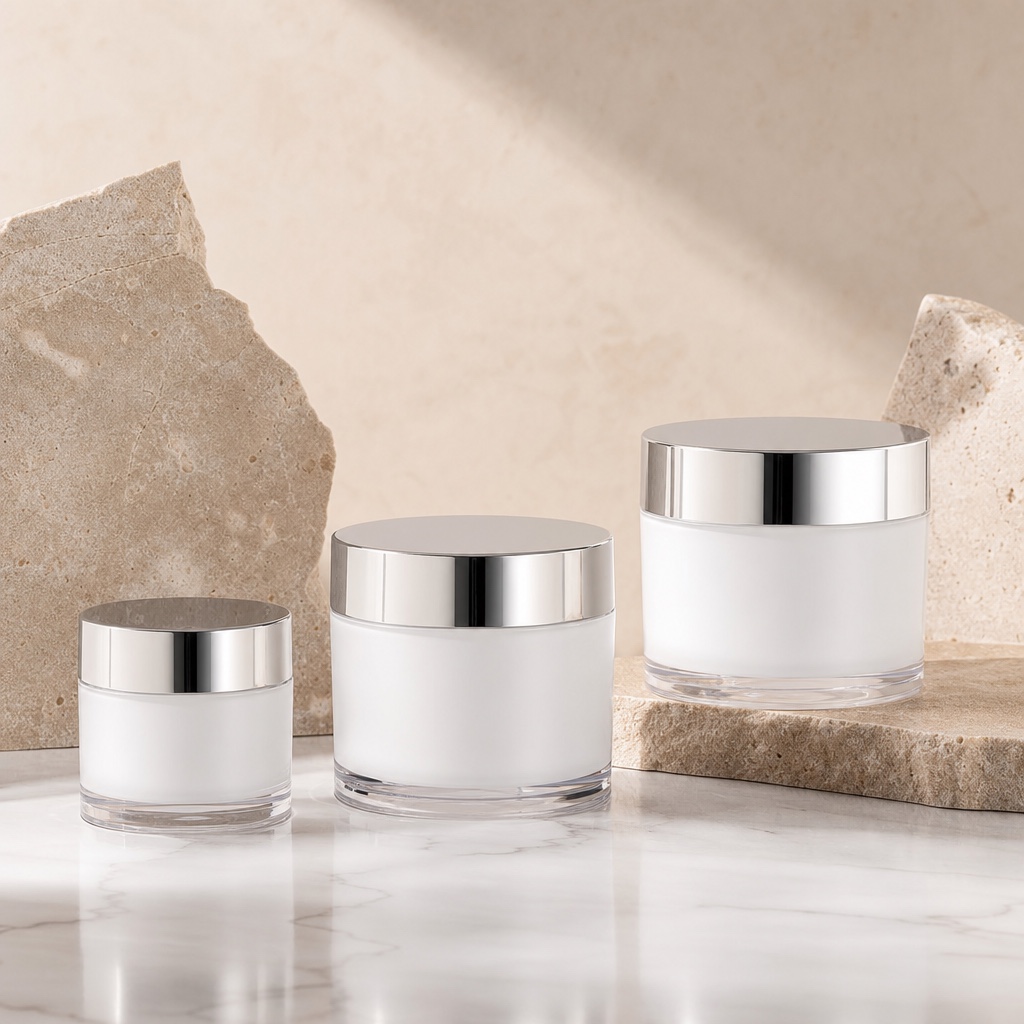
Often ordered alongside glass bottles.

Read before you brief us.
- Acrylic vs Glass vs PP Cream Jar: Which Is Right for a Moisturiser, and Why PMMA Needs a Liner
- Custom Glass Cosmetic Bottle Mould Cost and MOQ: Why the Floor Is 30,000 Pieces
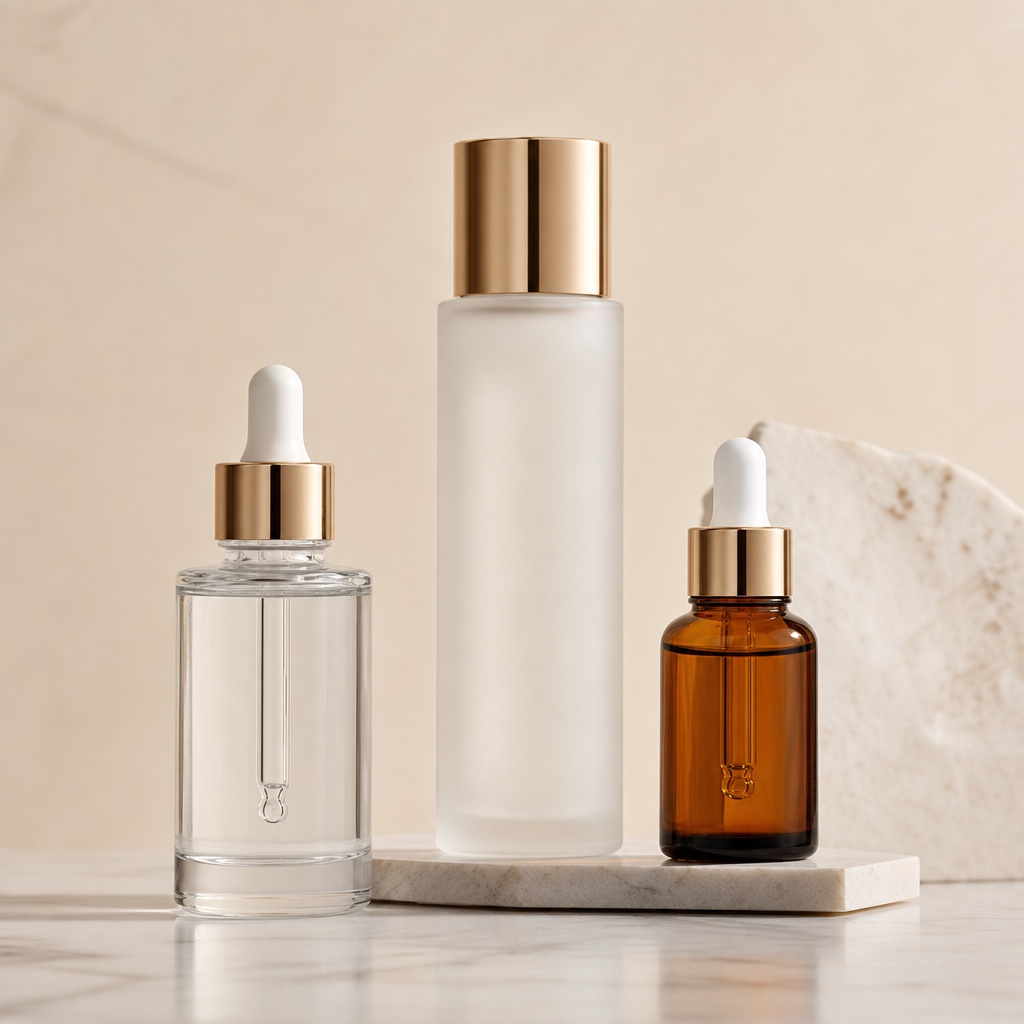
- Frosted vs Amber vs Clear Glass for a Serum Bottle: Protection, Decoration MOQ and Cost
- Frosted vs Sandblasted Glass Bottles: Acid Etch, Spray Frost and Sandblast Compared — Look, Cost, MOQ and Durability
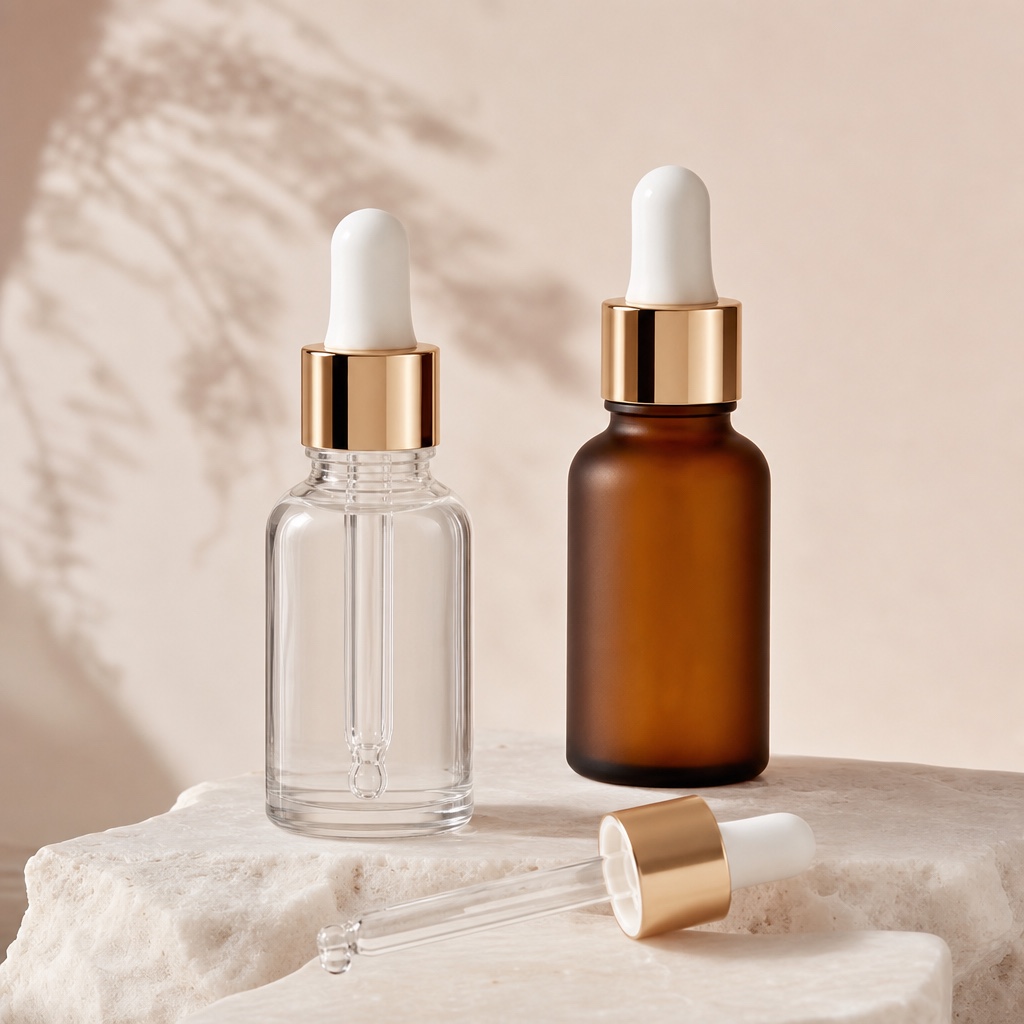
- Glass Pipette, Silicone or TPE Bulb: Choosing a Dropper for Facial Oils and Actives
- Lead-Free Glass for Cosmetic Bottles: Soda-Lime vs Borosilicate vs Crystal, How to Verify, and Heavy-Metal Limits
- Matte Black Glass Jars for Skincare at Low MOQ: Coating, Adhesion Test and Real Minimums
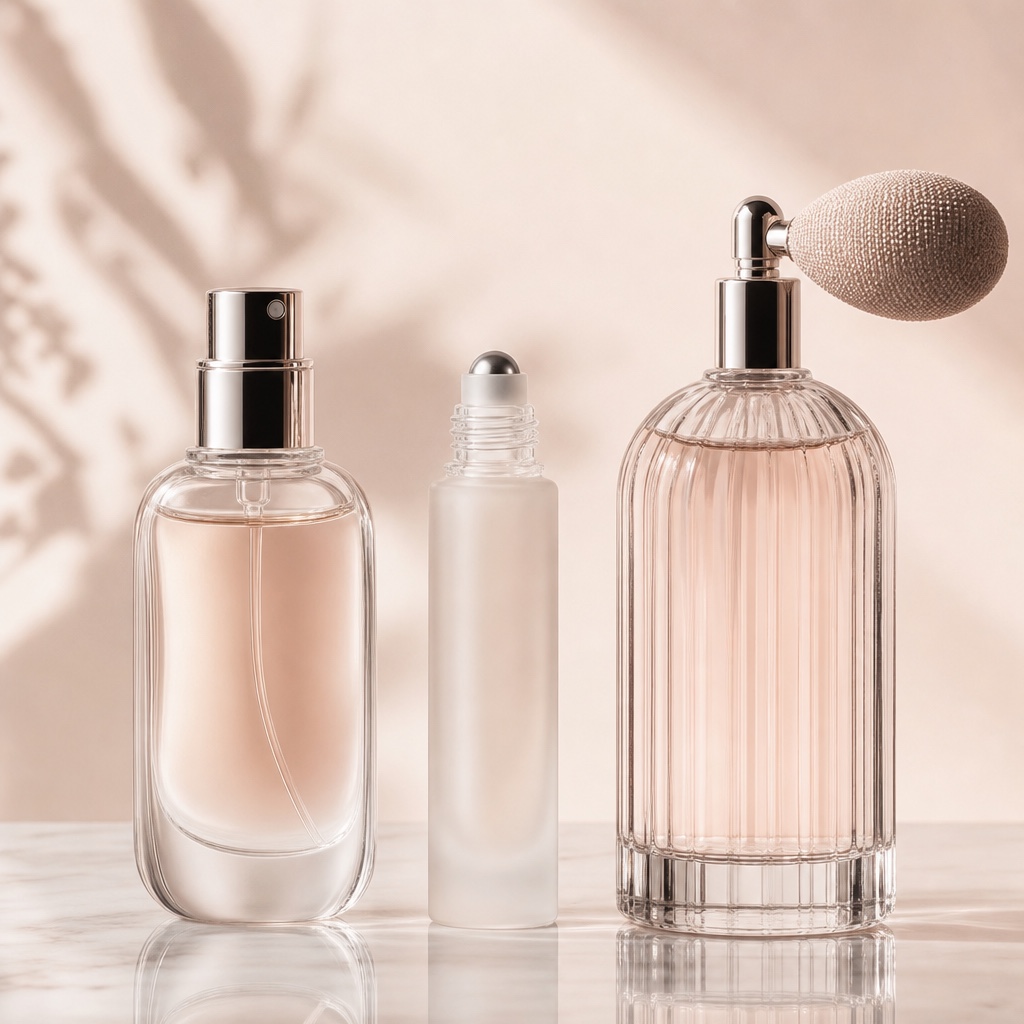
- Perfume & Fragrance Glass Bottles from China: A Sourcing Guide
- Sprayed Matte Black vs Coloured Glass Jar: Cost, MOQ and Durability Compared
- Toner Bottles: Glass vs PET, 100–200 ml Sizes, Flip-Top, Disc-Top and Spray Closures, MOQ
Not sure what to specify? Use the Packaging Spec Builder — formula, volume, quantity and launch date in, a 12-line spec sheet with MOQ verdict and order-by date out.
Tell us what you need,
we'll find it.
Send a brief — format, size, quantity, finish — and we'll come back with factory options, material recommendations and an indicative price within 24 hours.
Three things worth reading first.
- What eight China suppliers actually publish as their minimum order quantity — Dalica, Boyu, Gidea PAC, Topfeel Pack, UKPACK, Lisson, JingSourcing and Vella side by side, each figure quoted from that company’s own page. The published industry floor is 5,000–10,000 pieces per item, and this explains what moves it.
- Why a matched collection across bottles, jars and tubes is harder than it looks — a spray minimum attaches to the shape, not the colour, so six formats in one colour is six set-ups rather than one. Plus why two “white” components from the same brief can still fail to match.
- Sourcing partner, factory or trading company — which do you actually need? — eight questions that reveal which model a supplier really belongs to, including the honest case against using a sourcing partner at all.