Feel the difference.
Everything you need to
brief us in one page.
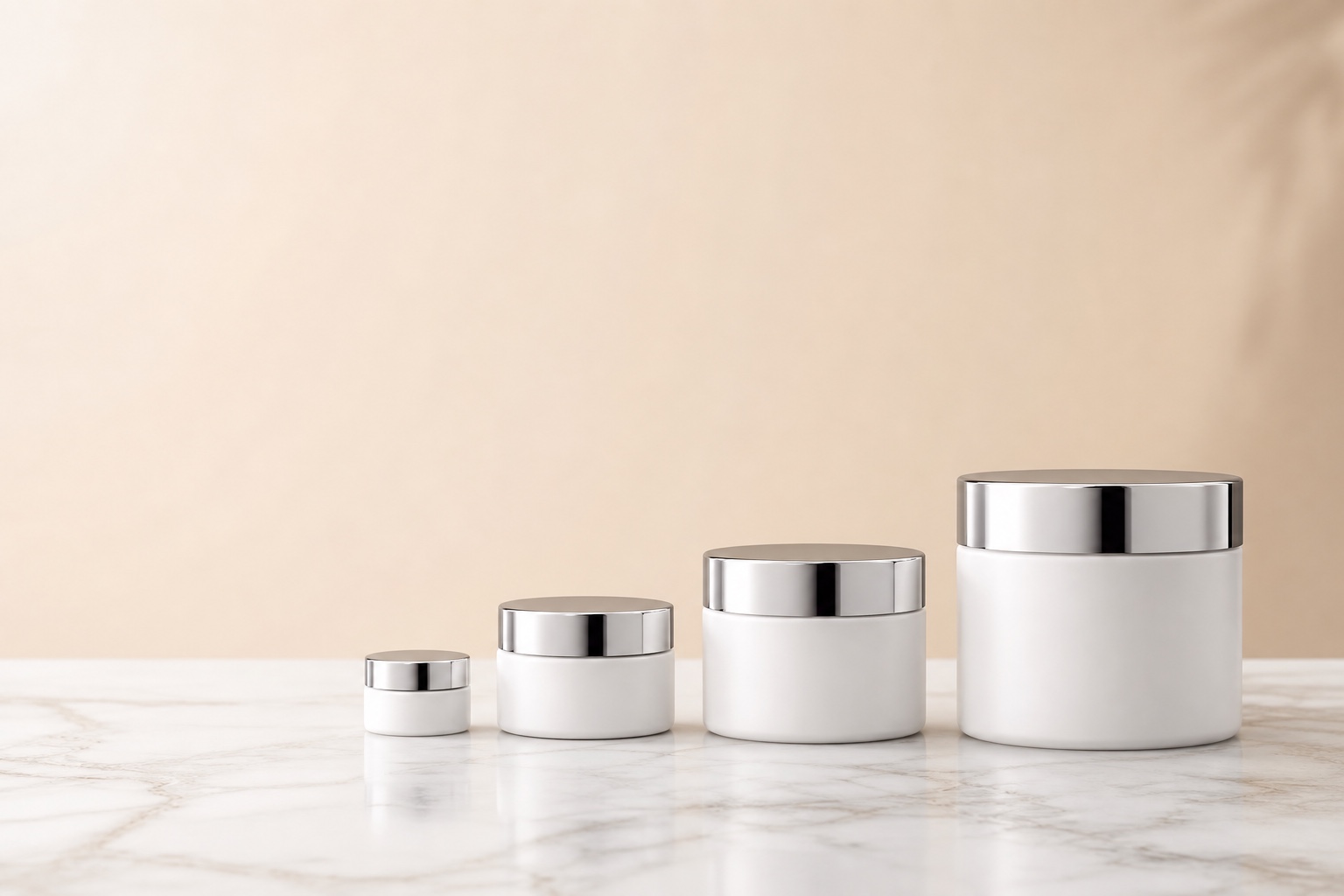
Custom sizes available
PCR-PP · PCR-PET · Bamboo lid
Jar-in-jar with inner refill pod
Metallised lid · Bamboo lid · Chrome
PP inner cup for cream/balm
Custom label (IML, shrink sleeve)
Glass: REACH · SGS certified
Custom tooling: 80–100 days
The lid-open experience
is part of the product.
The moment a consumer opens a jar is a sensory brand moment — the weight of the lid, the seal release, the first impression of the formula. Double-wall jars create a weighted, premium hand-feel that single-wall can't replicate. We help you spec the jar, the lid material and the inner cup together as one coordinated experience.
Cosmetic jars from China, with numbers.
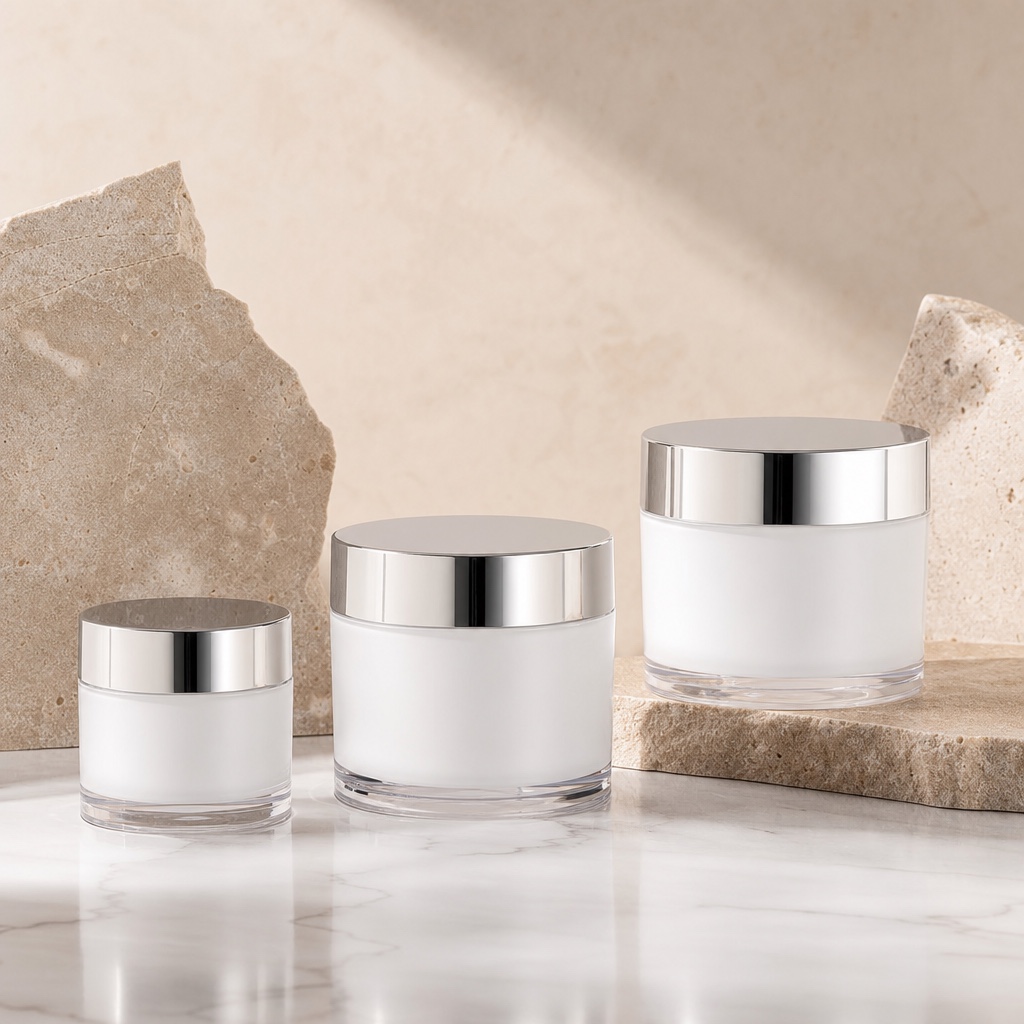
For a face-cream jar there are three real choices: glass (inert, best barrier, 2–3× the weight, from about 500 pieces stock), PP (chemically robust, the standard for acids and oils, from about 500 stock and 2,000 printed), and acrylic (PMMA) — which must never touch the bulk: every acrylic jar is specified with a PP inner cup, because oils and alcohol craze and cloud PMMA, and an acrylic jar quoted "without liner" is a quote for a different product. Nominal capacity is not fill capacity: the drawing specifies brim-full volume with a ±5% tolerance and a fill line with headspace below it, and a lined acrylic jar holds noticeably less than its outer size suggests. Stock jars ship in 7–25 days; a private jar mould is RMB 25,000–70,000 ≈ USD 3,500–9,700 and a 90–120 day programme.
Specification table — acrylic, glass and PP jars
| Parameter | Published value | Note |
|---|---|---|
| Capacities | 5, 10, 15, 20, 30, 50, 75, 100, 150, 200, 250, 300 ml (to 500 ml for body and mask) | 50 ml is the face-moisturiser standard; 15–30 ml eye and spot; 200–500 ml body butter and mask |
| Wide-mouth finishes | Ø33, Ø38, Ø43, Ø48, Ø63, Ø70, Ø83, Ø89, Ø100 mm | Ø43–Ø70 for 30–100 ml creams; Ø33, Ø38 for 15 ml eye |
| Materials — bulk contact | Glass (high-flint, opal, amber; press-formed) · PP (clarified or opaque) · PS clear (brittle) | Glass jars press-formed; PP inner cup mandatory inside PMMA |
| Materials — outer shell only | PMMA (acrylic) · AS (SAN) · ABS · Surlyn | PMMA: highest clarity and gloss, thick-wall heavy feel; stress-cracks from alcohols and oils; poor drop performance |
| Lid | PP, ABS or acrylic outer; PP or PE inner lid; disc liner; optional foil seal and spatula | Metallised or plated lids are exterior parts only — never in contact with bulk or skin; no nickel on touch surfaces |
| Capacity tolerance | Brim-full capacity ±5% (20°C water); fill line specified with headspace | Do not fill a lined acrylic jar to the brim — bulk creeping between cup and shell causes crazing |
| Acrylic weights and necks (bottle-jar family) | 10 / 15 / 20 / 25 / 30 / 35 / 40 / 45 g shells; Ø18/410, Ø20/410, Ø24/410, Ø28/410 on acrylic bottles | Weight is a specification line — heavier shells cost more resin and freight |
| Wall type | Single-wall · double-wall (weighted feel) · jar-in-jar with inner refill pod | Double-wall gap uniformity checked on 10 samples per batch |
| Dimensions | Fit-critical ≤0.5 mm; overall height / width ≤1.0 mm | Lid-to-jar thread clearance 0.1–0.8 mm |
MOQ · mould · lead time by route
| Route | Indicative minimum | Tooling | Factory-gate lead time |
|---|---|---|---|
| Stock glass or PP jar, undecorated, stock colour | From about 500 pcs via partner factories already tooled for small runs (sometimes lower, by the carton) | None | 7–10 days if in stock; 15–25 days if a run is required; glass 30–60 days |
| Stock jar + screen print / hot stamp | About 2,000 pcs | Screen or foil plate — trivial | +5–7 days |
| Stock jar or lid + sprayed custom colour | 2,000–5,000 pcs per shape; jar and lid are two set-ups | Colour-matching per shape | 30–40 days |
| Moulded-in custom colour (PP) | 5,000–10,000 pcs | Full material changeover and purge | 15–25 days |
| Electroplated, metallised or custom-colour lid | Around 10,000 pcs — this floor does not move | Racking only | 25–40 days including plating queue |
| Stock acrylic double-wall jar + PP cup | Typical partner-factory range 500–3,000 stock; 2,000–5,000 sprayed | None | 15–25 days |
| Private mould (your own jar shape) | 3,000–10,000 pcs plus tooling; quotes vary by a factor of three between factories — get three | RMB 25,000–70,000 ≈ USD 3,500–9,700 per tool; a mid-size 50–100 g jar body tool ≈ RMB 76,500 ≈ USD 10,600 on a full cost sheet; 4–8 cavities; paid 30/40/30; rated 800,000 cycles; owned by the brand | Mould 45–60 days; full programme 90–120 days — not justified at 2,000 pieces |
| Made-to-order glass jar | 30,000–200,000 pcs | ≈ RMB 4,000 ≈ USD 555 per cavity | 30–60 days |
| Buffer rule | — | — | Quoted cycle × 1.3; +15 days across Chinese New Year (6 February 2027); sea 18–25 days to US West Coast, 30–35 to Northern Europe, 20–25 to Australia; +5–10 days clearance each end |
QC thresholds a partner factory signs against
| Test | Method | Pass threshold |
|---|---|---|
| Seal (colour-water) | Jar 3/4 filled with dyed water, lid and inner lid fitted, lying and inverted on white paper in a vacuum chamber | −0.06 MPa for 5 min; no dye outside the seal area; −0.08 MPa for 15 min, loss ≤0.5% for volatile bulks |
| Static seal | Filled, lidded, inverted | 24 h, no leakage |
| Opening torque | Torque meter after application | Standard screw caps 0.2–0.7 N·m; larger wide-mouth lids agreed per diameter; reverse torque ≥2.5 N·m; no thread strip |
| Thermal cycling, filled | Oven +50 ± 2°C 24 h; freezer −10 to −15°C 24 h; 2 h room-temperature recovery (48°C / −15°C, 24–48 h in the wider battery) | No cracking, deformation, colour change, leakage of cream or water |
| Drop | Filled, onto concrete | 1.5 m at 45° with closure; no functional damage |
| Glass jar defects | Front (A) face | Stones over 1 mm rejected, none on sealing land or thread; clear jars: no black spots; specks and bubbles 1–2 of Ø ≤0.5 mm |
| Wall thickness (plastic) | Gauge | ≥0.3 mm; variation ≤0.3 mm |
| Decoration adhesion | 3M 600 over print / hot stamp; 3M 810 over 2 mm cross-hatched spray or plating | 10 passes, 45° pull, no lift; hot-stamp loss ≤0.5 mm²; sprayed pencil hardness ≥2H |
| Decoration position (lid) | Top artwork vs cap OD centre | Offset ≤0.6 mm; joint mis-step ≤0.3 mm |
| Colour | Against signed golden sample under D65 | ΔE within agreed tolerance; jar and lid judged side by side in one hand |
| Compatibility | Actual bulk in the PP cup or glass at 48°C for 30 days, ambient and cold controls | No discolouration, odour, swelling, crazing of the acrylic shell, or decoration attack |
| Cleanliness | 75% alcohol flush, light box | No particle >0.5 mm, no fibre >2 mm |
| Acceptance sampling | ISO 2859-1 general level II | AQL 0 critical, 1.0–1.5 major, 2.5–4.0 minor |
| Heavy metals | Third-party laboratory report | Pb+Cd+Hg+Cr(VI) ≤100 ppm (EU 94/62/EC) |
Compatibility — which jar for which formula
| Formula | Jar rule | Why |
|---|---|---|
| Face cream, night cream (emulsion 2,000–50,000 mPa·s) | Glass or PP jar with inner lid, foil seal and spatula; acrylic only with a PP cup; airless if it carries retinol or peptides | Jars give the best shelf presence and the worst hygiene after opening — the inner lid and seal are not optional |
| Vitamin C, retinol, peptide creams | Airless preferred; otherwise opaque glass or PP with foil seal, opaque carton | Oxygen and light: browning and potency loss |
| AHA/BHA, pH below 4 | Glass or PP; no plated or metal part in the bulk path | Acid etches coatings and plating |
| Balms, body butters, oil-rich masks, essential-oil formulas | Glass or PP; never AS or unlined PMMA | Oils and essential oils craze PMMA, attack AS, extract plasticisers |
| Gel and sleeping masks (may contain alcohol) | PP, PS clear or glass with a sealing inner lid | Gel dries at the surface unless the inner lid seals; alcohol crazes PMMA |
| Clay masks, cleansing powders | PP or glass wide-mouth Ø63–Ø89; moisture-tight disc liner | Moisture ingress cakes the product |
| Any acrylic (PMMA) jar | PP inner cup or inner bottle always; fill below the brim | PMMA must not touch the bulk; bulk between cup and shell causes crazing |
| Plated or metallised lid | Exterior only; inner lid in PP or PE | Nickel is a contact allergen; plating never contacts bulk or skin |
Decoration process × indicative MOQ
| Process | Suits | Indicative add-on | Effect on MOQ |
|---|---|---|---|
| Screen printing | Glass, PP, acrylic shell | Glass ≈ USD 0.014 per colour; cylinder = one colour | Almost none |
| Hot stamping | Lid top, shell | ≈ USD 0.055 per design; ≤2 passes with screen print | Small |
| Pad printing | Curved lids, small logos | Low; 1–5 s per piece | Almost none |
| Spray coating (opaque, matte, soft-touch, gradient) | Glass, PP after flame treatment, acrylic shell | ≈ USD 0.07–0.15 per piece class | 2,000–5,000 per shape |
| Frosting | Glass | Per jar by size | Moderate |
| Vacuum metallising | Lids, acrylic shells | Medium; ≈6 h per cycle | Set-up drives MOQ |
| Electroplating | ABS lids only | Medium–high | Around 10,000 |
| In-mould labelling | PP jars | Medium; label tied to the mould | Mould modification |
| Full-wrap label | Any stock jar | Lowest | From about 100–500 |
Six-module program for cosmetic jars
| Module | What we do for cosmetic jars | Deliverable |
|---|---|---|
| 1 Spec | Take formula type, viscosity, pH, ethanol %, oil content and target fill weight; fix glass, PP or acrylic-with-PP-cup, capacity and brim-full tolerance, wide-mouth finish (Ø43–Ø70), inner lid, foil seal, spatula and lid material; write the colour-water seal and torque thresholds into the drawing | Packaging Spec Sheet |
| 2 Source | Route jar, inner lid and outer lid to the partner factories already tooled for small runs; quote stock, stock-plus-decoration and private-mould with the real minimum per component | Quote + Supplier Options |
| 3 Sample | Jar, cup and lid as an assembled set; 48°C / 30-day test with your actual cream; colour-water seal at −0.06 MPa; torque on 20 samples; double-wall gap on 10 | Golden Sample + Compatibility Report |
| 4 Mould | Only where volume justifies it: DFM review, cavity count (4–8 for a 50–100 g body), itemised RMB / USD quote, 30/40/30 payment, ownership with the brand | Mould Ownership Agreement |
| 5 QC | IQC on lids and liners; IPQC on wall and gap; FQC against the golden sample; OQC to agreed AQL | Inspection Report |
| 6 Ship | Glass jars in suspended trays; jar and lid shipped assembled or separately per filling-line preference; ten-node calendar with ×1.3 buffer and CNY +15 days | Production Calendar + Packing Standard |
These are indicative ranges from our published references, applied through vetted partner factories operating to ISO 22716 / GMP — not a fixed Vella commitment. The PMMA liner rule and the other eight material rules are on the formula × packaging compatibility matrix; the thirteen finishing processes and what each does to your minimum are on decoration process comparison; the four inspection gates are on our QC standards. For a cream, serum and oil range planned together see skincare packaging solutions, and read how to evaluate a China packaging supplier before paying a deposit. If the cream carries retinol or peptides, compare airless bottles; for a matte black glass jar programme see matte black glass jars.
Related standards: ISO 2859-1 AQL · EU 94/62/EC heavy metals · GB/T 9286 cross-hatch · GB/T 6739 pencil hardness · 3M 600 / 3M 810 · D65 · mould cost and ownership · neck finish and closure standards · China production calendar.
Three jar checks most brands skip until it's too late.
A jar that looks perfect in a sample photo can fail in ways that only show at production scale — lid fit, seal integrity, inner coating compatibility. Vella tests all three before production approval.
Lid Torque & Seal
We measure opening torque on 20 samples (consumer target: 1–2 Nm). Over-tight lids damage the brand experience; under-tight lids risk accidental opening in transit. Seal quality is tested with an inversion drop test.
Inner Coating Compatibility
Acrylic and PP can react with certain actives over time. Any formula containing vitamin C, AHAs, retinol or high-concentration botanicals requires an inner lacquer coat or PP insert, which we verify during sample stage.
Decoration Registration
Screen-print and hot stamp must register accurately across the curved or flat surface of the jar body. We check all 4 edges of the print area for consistency before production approval — bleed, position and colour match.
Double-wall Gap Uniformity
In double-wall jars, the gap between inner and outer walls must be even all around. Uneven gaps show as visual distortion and feel cheap. We measure 10 samples per batch for gap uniformity before release.
Frequently asked about cosmetic jars.
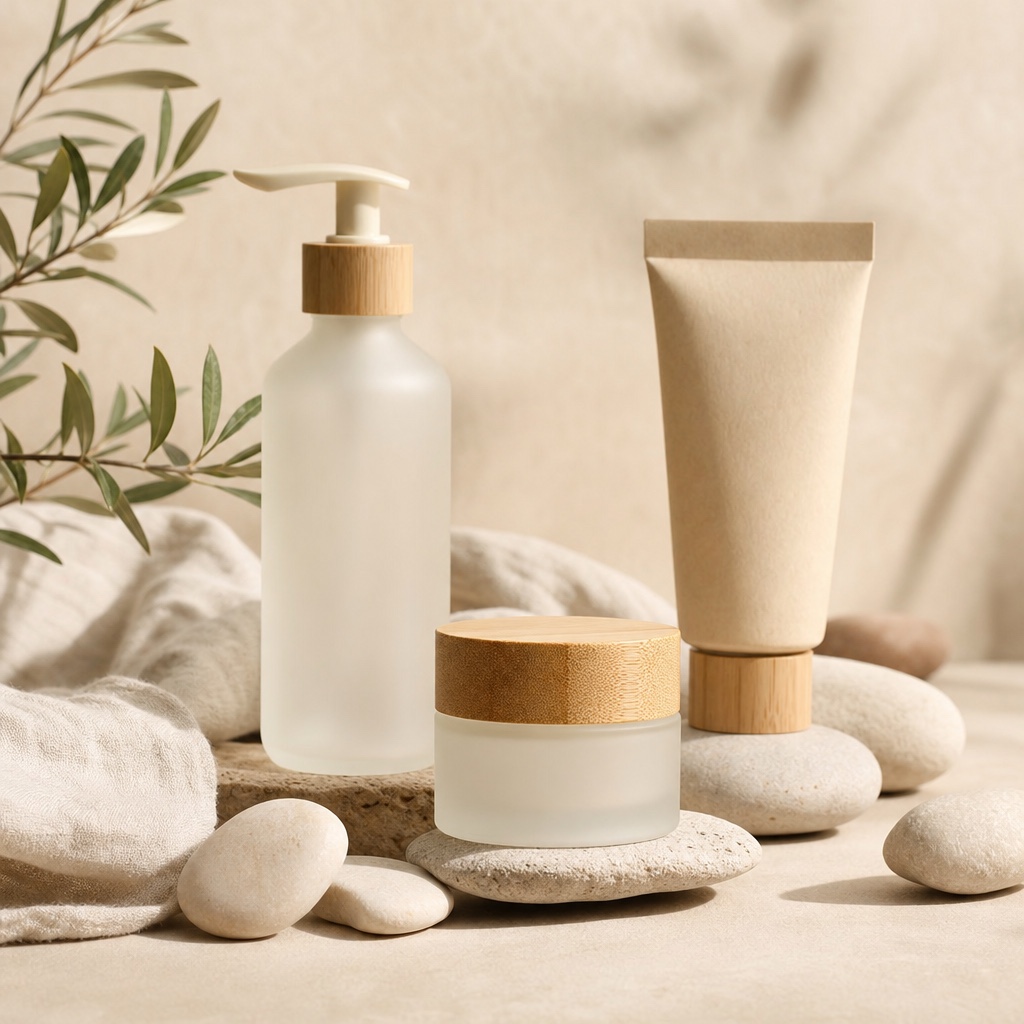
Often ordered alongside cosmetic jars.
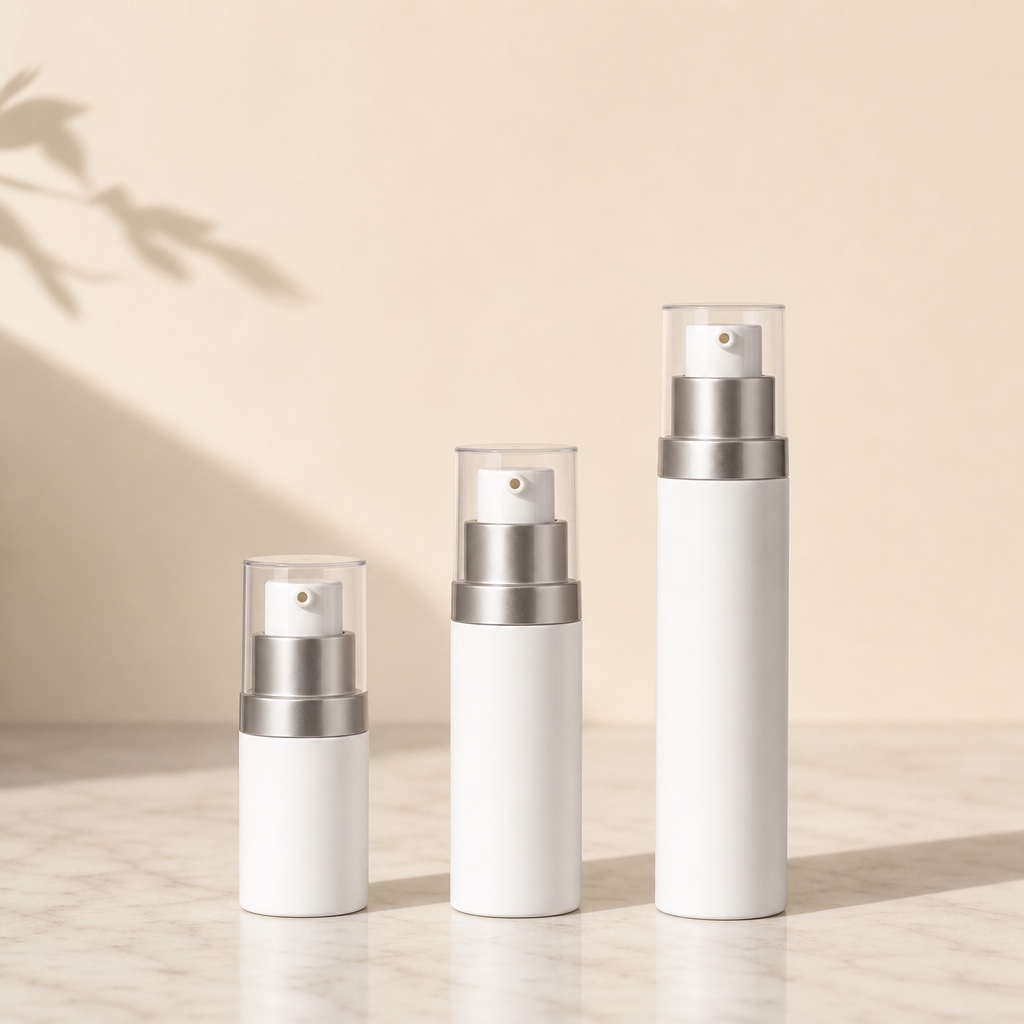
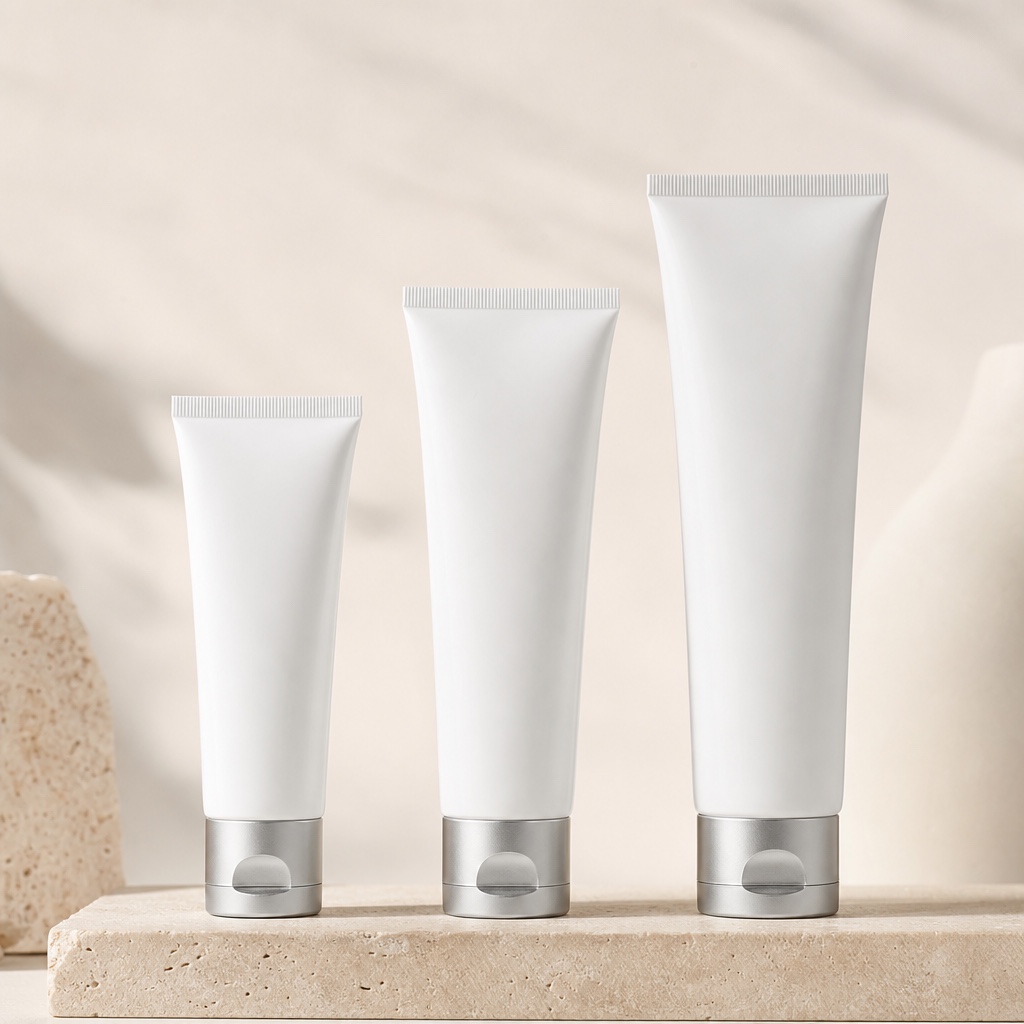
Read before you brief us.
- Acrylic vs Glass vs PP Cream Jar: Which Is Right for a Moisturiser, and Why PMMA Needs a Liner
- Body Butter Containers: 100–500 ml Jars in PP, PET and Glass, Wide-Mouth Closures, MOQ and Lead Time
- Cosmetic & Cream Jars from China: A Sourcing Guide for Skincare Brands
- Cosmetic Jar MOQ and Lead Time from China (2026): Acrylic, Glass and PP by Route
- Matte Black Glass Jars for Skincare at Low MOQ: Coating, Adhesion Test and Real Minimums
- Refill Pouch vs Inner Cartridge vs Jar Pod: Which Refill Format Is Cheapest to Launch?
- Sprayed Matte Black vs Coloured Glass Jar: Cost, MOQ and Durability Compared
- Why a 50 ml Cosmetic Jar Holds Less Than 50 ml: Brim-Full, Fill Line and Headspace Explained
Not sure what to specify? Use the Packaging Spec Builder — formula, volume, quantity and launch date in, a 12-line spec sheet with MOQ verdict and order-by date out.
Tell us what you need,
we'll find it.
Send a brief — format, size, quantity, finish — and we'll come back with factory options, material recommendations and an indicative price within 24 hours.
Three things worth reading first.
- What eight China suppliers actually publish as their minimum order quantity — Dalica, Boyu, Gidea PAC, Topfeel Pack, UKPACK, Lisson, JingSourcing and Vella side by side, each figure quoted from that company’s own page. The published industry floor is 5,000–10,000 pieces per item, and this explains what moves it.
- Why a matched collection across bottles, jars and tubes is harder than it looks — a spray minimum attaches to the shape, not the colour, so six formats in one colour is six set-ups rather than one. Plus why two “white” components from the same brief can still fail to match.
- Sourcing partner, factory or trading company — which do you actually need? — eight questions that reveal which model a supplier really belongs to, including the honest case against using a sourcing partner at all.