the last drop.
Everything you need to
brief us in one page.
Custom sizes available
PCR 30–100% recycled content
Ultra-slim travel format
Locking travel pump available
Metallised silver / gold / rose gold
FDA 21 CFR · EU 10/2011 · REACH
Sleeve labelling · UV coating
Near-complete product use
Custom tooling: 90–120 days
Available finishes
PP or PETG? It depends on
what's inside.
PP (opaque, matte-able) is the luxury default — takes finishes beautifully, excellent chemical resistance, available in PCR. PETG (transparent) lets consumers see formula colour and level — better for gel serums but not recommended for high-alcohol formulas.
Airless bottles from China, with numbers.
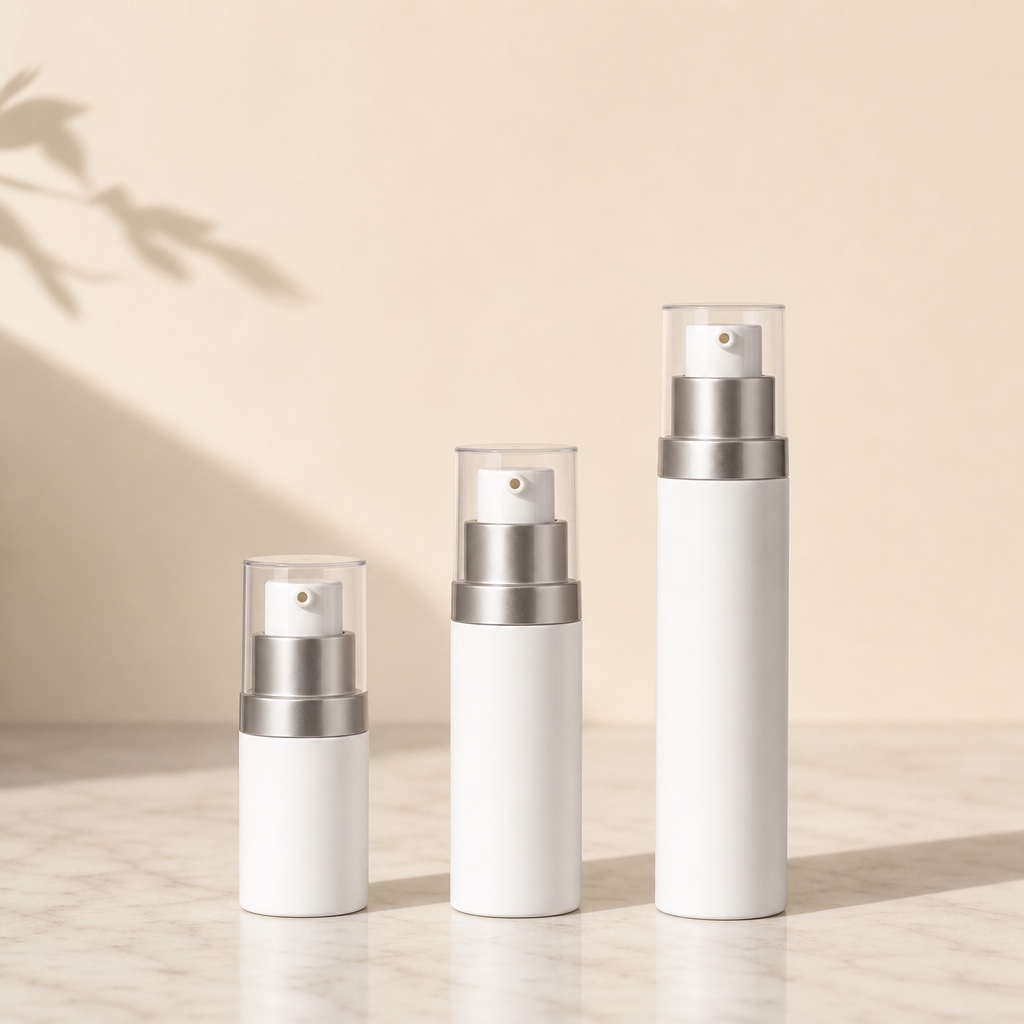
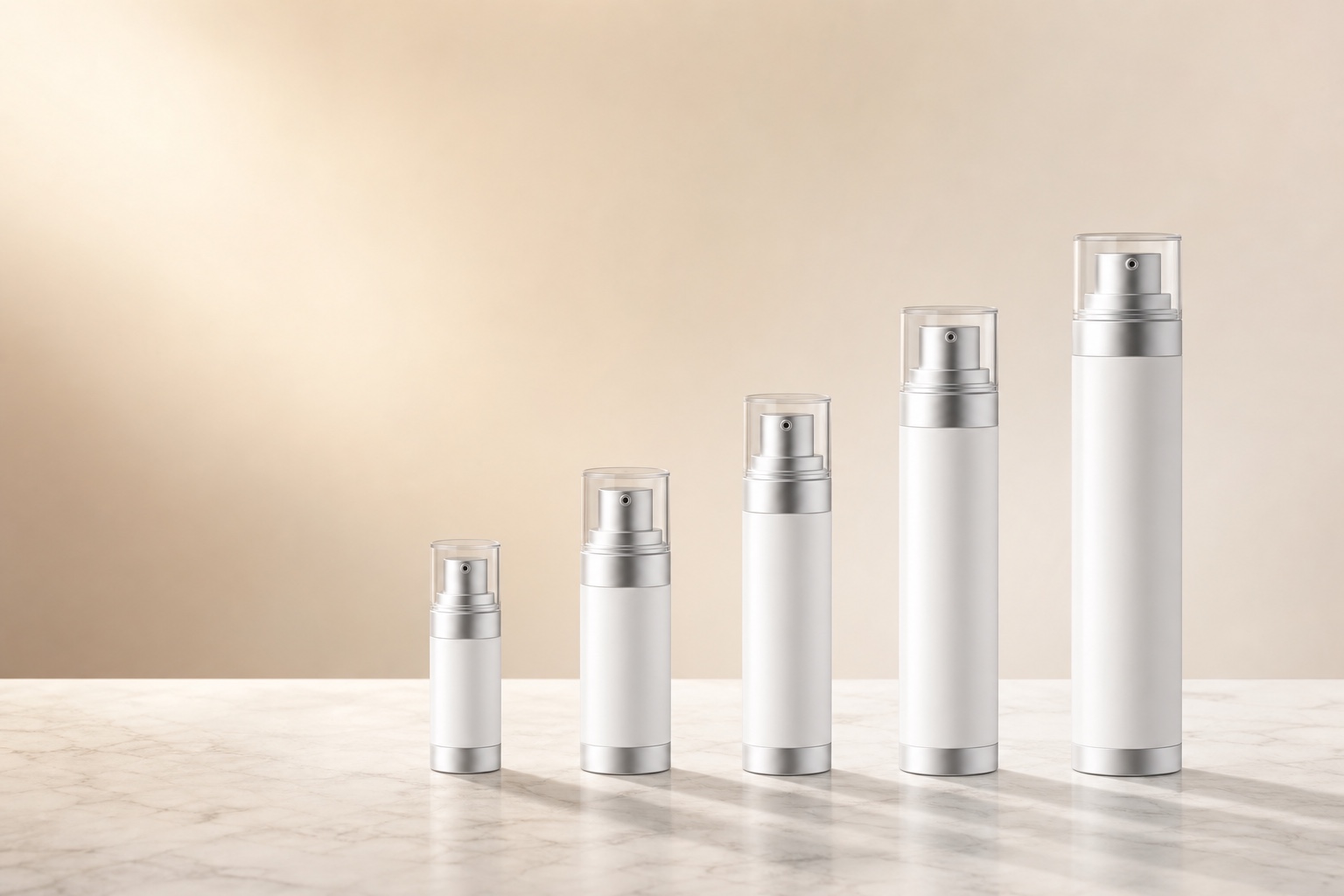
The real minimum order quantity for a stock-mould airless pump bottle from China is about 10,000 pieces per item, against roughly 500 pieces for a plain stock bottle, because the piston, pump group and body are separate sub-assemblies with their own set-ups. Dose is fixed by pump diameter, stroke and spring and is repeatable to about 0.05 ml: 0.15–0.2 cc per stroke for eye and serum, 0.5–1.0 cc for cream. PP is the opaque, chemically robust, PCR-capable default; PETG is the clear option — choose an alcohol-rated grade and never assume a stock grade tolerates a high-ethanol formula. Stock airless ships from the factory gate in 20–30 days; a private-mould airless is a full 90–120 day programme.
Specification table — airless pump bottles
| Parameter | Published value | Note |
|---|---|---|
| Capacities | 10–100 ml (15 · 30 · 50 · 80 · 100 · 150 ml stock sizes; 15–50 ml is the skincare sweet spot) | The format relies on atmospheric pressure, so it suits smaller volumes; there is no glass airless — the piston needs a wall with some compliance |
| Body materials | PP (opaque, matte-able, PCR 30–100%) · PETG (clear, alcohol-rated grades exist) | Outer decorative sleeve in PETG, AS or PMMA where the outer is metallised or sprayed — the outer never touches the bulk |
| Piston | PP | Friction between piston and inner wall governs both air-tightness and travel; piston fit is the first parameter qualified |
| Dose per stroke | 0.15 / 0.2 cc (eye, serum) · 0.5 / 0.7 cc · 1.0 cc (cream) | Repeatable to about 0.05 ml once diameter, stroke and spring are set; tunable by swapping pump parts |
| Dose tolerance | Single stroke ±15%; run average within 5–10% of specified | Weighed over 50 strokes × 3 after 15 priming strokes |
| Priming | ≤8 strokes (coloured water) · ≤10 strokes (lotion) | Bottle filled three-quarters |
| Thread clearance, outer cap to body | 0.1–0.8 mm | No thread strip at rated torque on a torque meter |
| Dimensions | Fit-critical ≤0.5 mm; overall height / width / depth ≤1.0 mm | Callipers and gauges on mating and overall dimensions |
| Structures | Standard single body · single-bottle composite (decorative outer) · twin-bottle (two-phase) · non-piston self-sealing valve (mono-material) | Cylindrical bodies are far more common than square |
| Service life | ≥1,500 continuous actuations; actuator returns in ≤3 s | Same threshold as lotion pumps and sprayers |
MOQ · mould · lead time by route
| Route | Indicative minimum | Tooling | Factory-gate lead time |
|---|---|---|---|
| Stock mould, stock colour, undecorated | Industry floor is around 10,000 pcs per item; lower runs occasionally via partner factories holding assembled stock | None | 20–30 days (piston and pump sub-assemblies come from separate lines) |
| Stock mould + screen print / hot stamp | Around 10,000 pcs; print itself adds almost nothing to the floor | Screen or foil plate only (trivial) | 20–30 days + 5–7 days |
| Stock mould + sprayed custom colour or metallised sleeve | 10,000 pcs, and 2,000–5,000 per shape for the spray line — the higher of the two applies | Colour-matching set-up per shape; no mould | 30–40 days for spray; metallising ≈6 h per chamber cycle plus queue |
| Stock mould + electroplated collar or cap | Around 10,000 pcs — this floor does not move | Racking only | 25–40 days including plating queue |
| Private mould (your own body / sleeve shape) | Typical partner-factory range 10,000–30,000 pcs on first run plus tooling | RMB 25,000–70,000 ≈ USD 3,500–9,700 per component mould; an airless set is several tools (body, sleeve, cap), paid 30/40/30, rated 800,000 cycles, owned by the brand | Mould 45–60 days; full programme brief → mass production 90–120 days; plan launch 5–6 months from brief |
| Buffer rule (all routes) | — | — | Quoted cycle × 1.3; +15 days across Chinese New Year (6 February 2027); then sea 18–25 days to US West Coast, 30–35 to Northern Europe, 20–25 to Australia, +5–10 days clearance each end |
QC thresholds a partner factory signs against
| Test | Method | Pass threshold |
|---|---|---|
| Vacuum leak | Filled, lying and inverted on white paper in a vacuum chamber | −0.05 MPa for 5 min (line quick check) or −0.08 MPa for 15 min, loss ≤0.5% (inspection report); standard emulsions at −0.06 MPa, volatile formulas at −0.08 MPa; no trace on the paper |
| Piston seal, static | Cool 4 h after moulding, assemble piston and body, fill with water, stand 4 h | Resistance felt on the piston; no water passes |
| Piston travel, dynamic | Stand 4 h, fit pump, dispense to empty | Piston rises cleanly to the top; contents fully expelled |
| Inner–outer bottle pull | Tensile tester on collar-to-outer assembly | ≥50 N without separation; no rubbing between inner and outer wall |
| Inner plug retention | Axial pull | ≥30 N; gasket ≥1 N |
| Anodised aluminium trim bond | Glued, cured 24 h, pulled | ≥50 N |
| Output per stroke | Weighed over 50 strokes × 3 | Single stroke ±15%; average within 5–10% of dose |
| Pump life | Continuous actuation | ≥1,500 cycles; priming ≤8–10 strokes |
| Thermal cycling, filled | Oven and freezer | 48°C and −15°C, 24–48 h each; no cracking, warping, leakage or colour change after 2 h recovery |
| Drop, filled and capped | Onto concrete | 1.5 m at 45° for bottles with closure; no functional damage |
| Decoration adhesion | 3M 600 over print / hot stamp; 3M 810 over 2 mm cross-hatched spray, metallising or plating | 10 passes, pulled at 45°, no lift; hot-stamp loss ≤0.5 mm²; sprayed surface pencil hardness ≥2H |
| Colour | Against signed golden sample under D65 light | ΔE within the tolerance agreed per material; family components judged side by side |
| Torque | Torque meter on outer cap | Opening 0.2–0.7 N·m for standard caps; no thread strip at rated tightening |
| Acceptance sampling | ISO 2859-1 general level II | AQL 0 critical, 1.0–1.5 major, 2.5–4.0 minor, agreed before production |
| Heavy metals | Third-party laboratory report | Pb+Cd+Hg+Cr(VI) ≤100 ppm (EU 94/62/EC); REACH documentation on request |
| Visual inspection | 100 W cool-white lamp at 50–55 cm | 500–550 lux, 30–35 cm eye distance, 45° ± 15°, ≤12 s per piece |
Formula compatibility — PP vs PETG and the hard rules
| Formula condition | What goes wrong | Rule for airless |
|---|---|---|
| Water-based serum, light emulsion | Nothing material-specific; the question is dose and priming | PP or PETG body; 0.15–0.2 cc pump; test priming with your bulk — a cream that primes in 5 strokes with water can need 15 with oil |
| Vitamin C, retinol, peptides (oxygen-sensitive) | Browning, loss of potency, odour | Airless is the standard answer: no returning air, residue near zero; pair with opaque PP or a sprayed sleeve for light protection |
| Ethanol above ~30% | PET-class plastics swell, haze and deform; standard gaskets soften | PP body, or a PETG grade rated for the alcohol level written into the spec (e.g. ≥50%); solvent-grade gaskets; test at −0.08 MPa |
| Essential oils, fragrance concentrates, silicone-heavy oil serums | Attack AS, craze PMMA, swell NBR/TPE gaskets; low surface tension creeps past seals | PP body; AS or PMMA only as a non-contact outer sleeve; gasket proven against the oil in the 48°C / 30-day test |
| pH below 4 (AHA/BHA) | Acid corrodes standard pump springs and etches plating | PP body; pump with 316 stainless or plastic spring, or spring outside the fluid path |
| Thick cream 2,000–50,000 mPa·s | Under-dosing, stalled piston | 0.5–1.0 cc pump; high-viscosity pump structure; verify piston travel to empty with the actual bulk |
| Any of the above | — | Accelerated compatibility: actual bulk at 48°C for 30 days with 25°C and cold controls, ≥3 units per condition; weight loss ≤0.5% for volatile bulks |
Decoration process × indicative MOQ
| Process | Suits (airless) | Indicative add-on | Effect on MOQ |
|---|---|---|---|
| Screen printing | PP and PETG body, sleeve | Low; approx. USD 0.014 per colour on glass-class pricing; cylinder = one colour | Almost none |
| Hot stamping | Body, cap, collar | Low; approx. USD 0.055 per design; ≤2 passes together with screen print | Small |
| Spray coating (matte, soft-touch, gradient) | PP after flame treatment; PETG | Approx. USD 0.07–0.15 per piece class | 2,000–5,000 per shape |
| Vacuum metallising (silver, gold, rose gold) | Outer sleeve, collar, cap | Medium; ≈6 h per cycle, no tooling | Set-up drives MOQ |
| Electroplating | ABS cap or collar only; never in contact with skin or bulk; no nickel on touch surfaces | Medium–high | Around 10,000 |
| Moulded-in colour | PP body | Low per unit, full material changeover | 5,000–10,000 |
| Full-wrap label / shrink sleeve | Any stock body | Lowest | From about 100–500 pieces |
Six-module program for airless bottles
| Module | What we do for airless bottles | Deliverable |
|---|---|---|
| 1 Spec | Take formula type, viscosity, ethanol %, pH and target dose; fix PP or PETG body, capacity, pump output (0.15–0.2 cc or 0.5–1.0 cc), structure (single, composite, twin, non-piston) and finish; write the leak, priming and dose thresholds into the drawing | Packaging Spec Sheet |
| 2 Source | Route to the partner factory already tooled for the structure you need; quote stock, stock-plus-decoration and private-mould options with the real minimum per component | Quote + Supplier Options |
| 3 Sample | Physical samples filled with your actual bulk; 48°C / 30-day compatibility, priming count, 50-stroke × 3 dose weighing, −0.08 MPa / 15 min leak | Golden Sample + Compatibility Report |
| 4 Mould | Only where volume justifies it: DFM review, 30/40/30 payment tied to design sign-off, ownership with the brand, capacity reserved at 120%, ±10% price trigger, second-source clause | Mould Ownership Agreement |
| 5 QC | IQC on pump groups before assembly, IPQC on piston fit, FQC against the golden sample, OQC to agreed AQL; the full test sheet above | Inspection Report |
| 6 Ship | Ten-node calendar with ×1.3 buffer and CNY +15 days; export cartons specified per weight; consolidation with jars, droppers and cartons from other partner factories into one shipment | Production Calendar + Packing Standard |
These figures come from our engineering references and apply as indicative ranges through vetted partner factories operating to ISO 22716 / GMP — not as a fixed Vella commitment. The full test sheet is on the airless, pump and sprayer specifications page; the nine material rules are on the formula × packaging compatibility matrix; the four inspection gates are on our QC standards. For the whole serum-and-cream range see skincare packaging solutions, and before you commit a deposit read how to evaluate a China packaging supplier. If a pump is not required, the alternatives are dropper bottles for oils and thin serums and cosmetic jars for thick creams.
Related standards: ISO 2859-1 (AQL sampling) · EU 94/62/EC (heavy metals ≤100 ppm) · GB/T 9286 cross-hatch adhesion · 3M 600 / 3M 810 tape adhesion · D65 colour assessment · China production calendar · mould cost and ownership.
Four things most buyers never test before it's too late.
Airless bottles are mechanically complex. The piston must advance correctly, the vacuum must hold, the evacuation rate must be reliable, and materials must be compatible with your formula.
Pump Stroke Consistency
The piston must advance exactly one increment per pump actuation. We test 50 units per sample batch — inconsistent dispensing damages the brand experience.
Evacuation Rate Protocol
Fill with viscosity-matched liquid, pump to air-lock, weigh residue. Any bottle evacuating less than 93% fails our standard before production approval.
Material Certification
PP and PETG must carry food-contact or cosmetic-contact certifications from the resin supplier. We require the certificate — not a factory declaration.
Formula Compatibility
Thick actives, high-alcohol formulas and silicone-heavy textures all affect pump performance differently. We test before approving production — not after.
Frequently asked about
airless bottles.
Often ordered alongside airless bottles.
Read before you brief us.
- Airless Pump Bottle MOQ and Lead Time from China (2026): Real Numbers by Route
- Airless Pump Bottles from China: A Sourcing Guide for Indie Skincare Brands
- Airless vs Regular Pump Bottle for Serum: Which Should an Indie Brand Choose?
- Airless vs Tube for Sunscreen: Dose, UV Protection, Cost and MOQ
- Why Airless Bottles Fail QC: Evacuation, Dose, Piston and Leak Tests Explained
Not sure what to specify? Use the Packaging Spec Builder — formula, volume, quantity and launch date in, a 12-line spec sheet with MOQ verdict and order-by date out.
Tell us what you need,
we'll find it.
Send a brief — format, size, quantity, finish — and we'll come back with factory options, material recommendations and an indicative price within 24 hours.
Three things worth reading first.
- What eight China suppliers actually publish as their minimum order quantity — Dalica, Boyu, Gidea PAC, Topfeel Pack, UKPACK, Lisson, JingSourcing and Vella side by side, each figure quoted from that company’s own page. The published industry floor is 5,000–10,000 pieces per item, and this explains what moves it.
- Why a matched collection across bottles, jars and tubes is harder than it looks — a spray minimum attaches to the shape, not the colour, so six formats in one colour is six set-ups rather than one. Plus why two “white” components from the same brief can still fail to match.
- Sourcing partner, factory or trading company — which do you actually need? — eight questions that reveal which model a supplier really belongs to, including the honest case against using a sourcing partner at all.