that sells itself.
Everything you need to
brief us in one page.
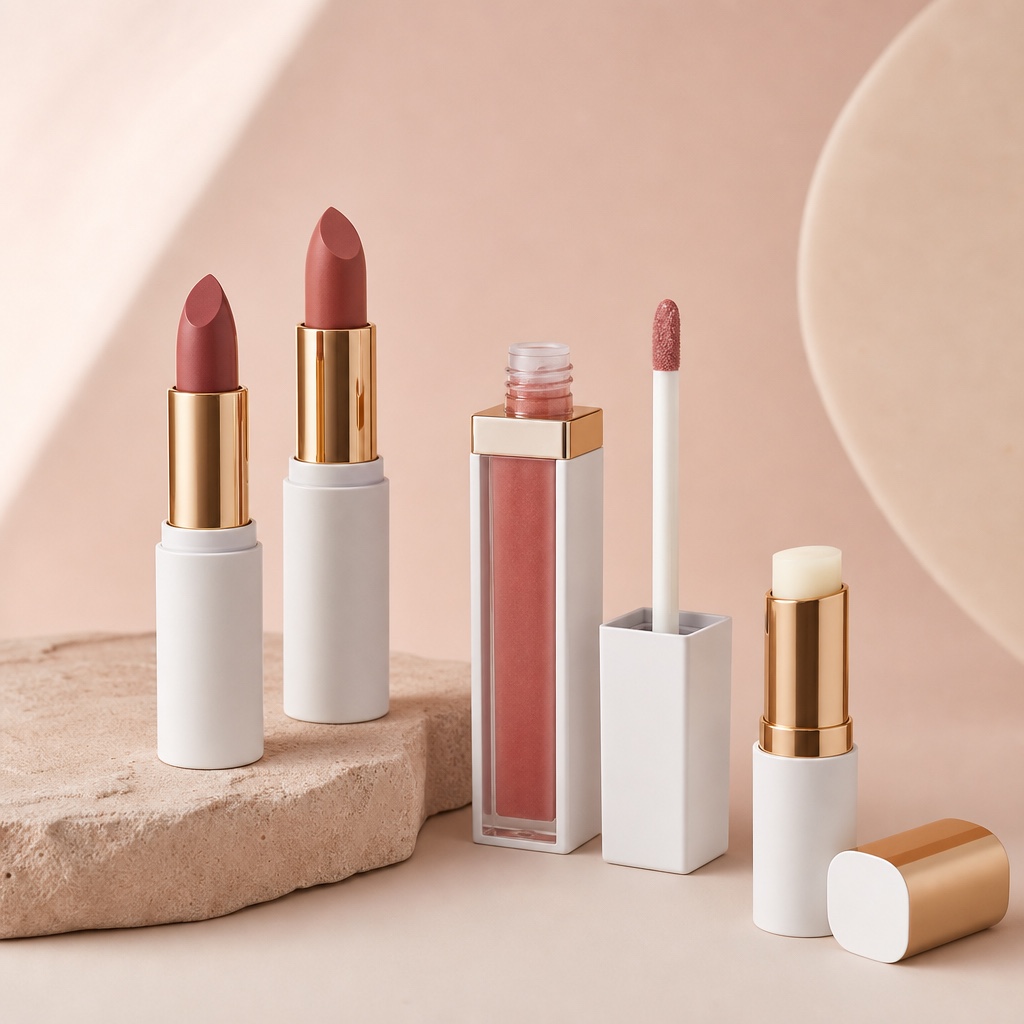
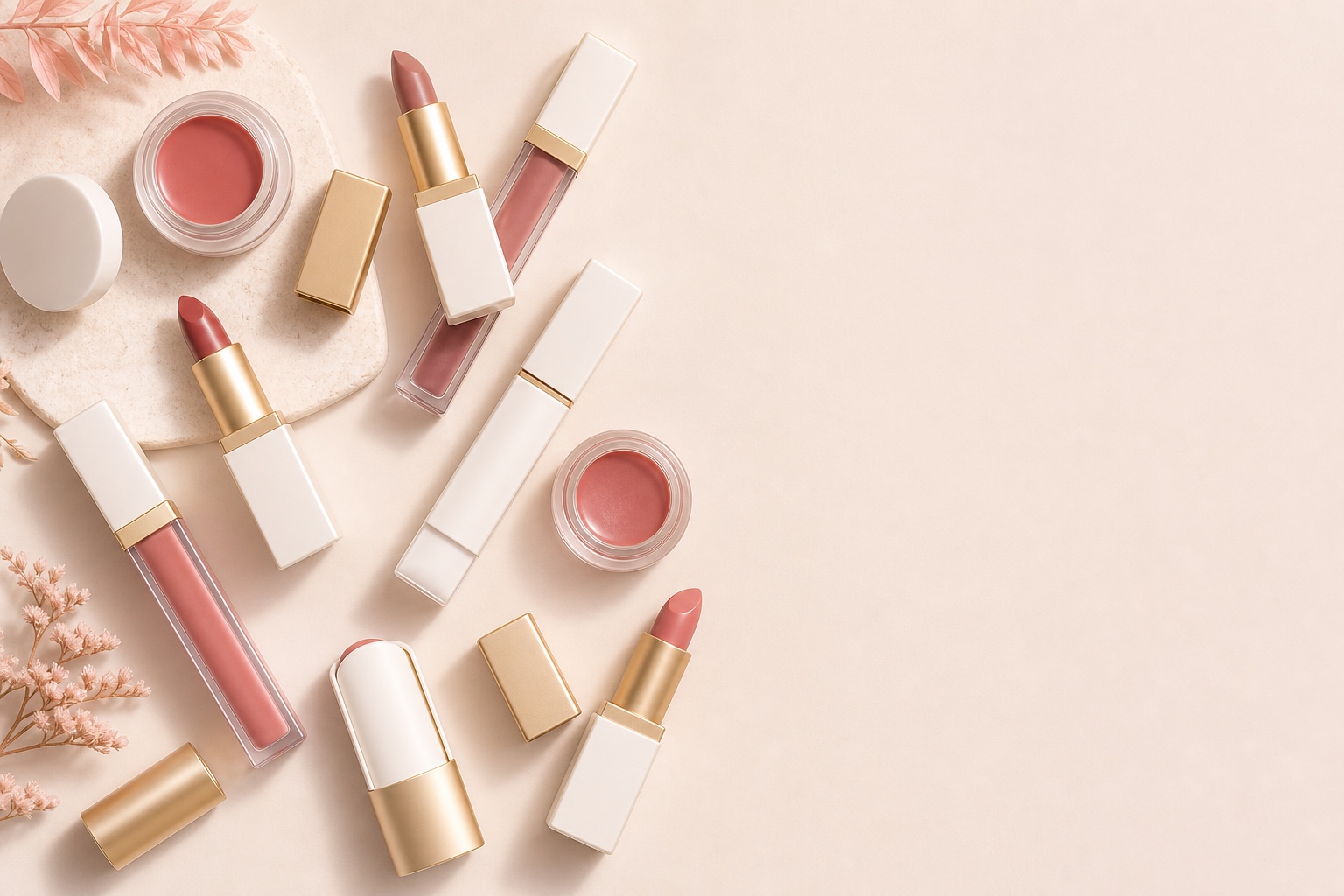
Lipstick bullets: 3.5–4.5 g
PCR-ABS · Eco-friendly clear PETG
Lip balm sliding tube · Lip tint pot
Plumping tip · Brush-tip · Cushion tip
Metallised gold / silver / rose gold
Foil label · Deboss on cap
Pantone matching available
Custom mechanism: 80–90 days
The applicator changes
how the formula performs.
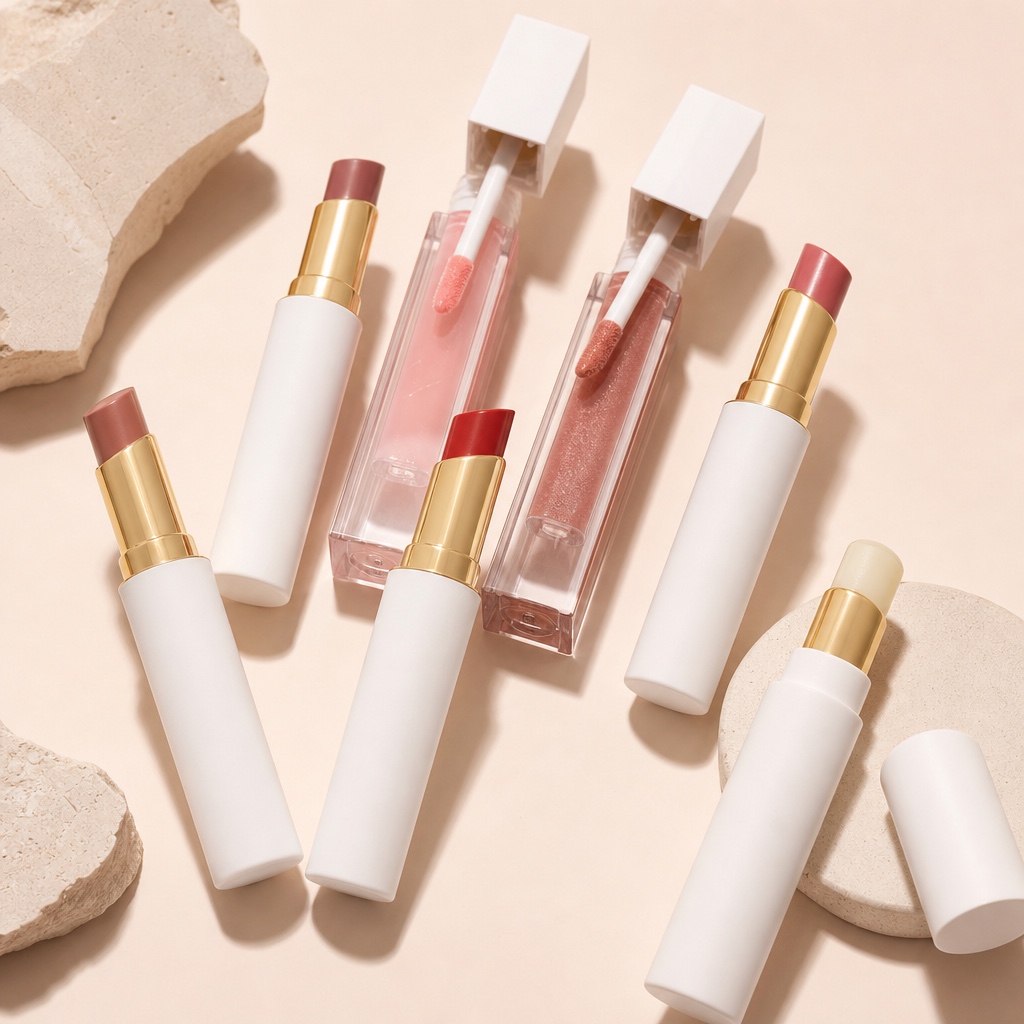
Lip packaging is unusual in cosmetics — the applicator (wand type, tip shape, fibre density) directly affects how the formula deposits on the lip. A plumping gloss needs a different tip than a sheer lip oil. We help brands spec the applicator to match the formula texture and the positioning story, not just the outer shape they like.
Lip packaging, with numbers.
A stock (public-mould) lipstick mechanism or lip gloss tube carries no tooling; a custom-decorated stock gloss tube starts around 1,000 pieces, moulded-in custom colour around 3,000, sprayed colour 2,000–5,000 per shape and electroplating around 10,000 — a floor that does not move. A stock mechanism with decoration ships in about 30–45 days at factory gate, a custom mechanism in 80–90 days, and a private mould costs RMB 25,000–70,000 (≈USD 3,500–9,700) per component tool, paid 30/40/30, inside a 90–120 day programme. Before approving any mechanism, check the cup inner diameter (8.5–12 mm standard sizes), rotation torque 0.1–0.5 N·m and a full cycle after a 45°C hold with your actual bullet. The figures come from vetted partner factories operating to ISO 22716 / GMP in the Shantou and Yuyao–Shangyu colour-cosmetics clusters.
Specification: the four lip formats
| Format | Parts and materials | Key dimensions | Stock options |
|---|---|---|---|
| Lipstick mechanism (twist-up bullet) | Cap (aluminium, ABS, PMMA or PETG), base (ABS or aluminium), core with cup, fork and spiral (PP, POM or ABS); aluminium 1070 / 5657; zinc alloy for premium parts | Cup ID 8.5 / 8.6 / 9 / 9.8 / 10 / 11 / 11.8 / 12 mm; 4, 6 or 8 ribs; bullet 3.5–4.5 g; double-spiral 'fast' thread; bottom-fill or top-fill | Stock mechanisms in 3.5–4.5 g sizes; magnetic caps as a stock option; avoid glued weights in the base |
| Lip gloss tube + wand | Tube in PP, PETG or AS; cap in ABS or PP; wand stem in PP; applicator doe-foot, flat, plumping, cushion or brush; wiper in LDPE or TPE | 3.5–15 ml, 4.5 ml typical; wiper bore set to the wand stem; cap stays closed under 1 kg bag compression | Custom-decorated stock tubes from ~1,000; moulded-in colour from ~3,000; applicator approved with the formula |
| Click / mechanical pencil (crayon, liner, brow) | Push-button or twist cartridge in PP / ABS; replaceable refill; brush or sharpener cap | Click advance per press; cartridge diameter matched to the crayon; cap retention under 1 kg compression | Stock cartridges in standard diameters; custom only for hero products |
| Lip balm tube / tint pot | Oval or round twist tube in PP; pot in PP, glass or aluminium with disc liner | Balm tubes 4–5 g typical partner-factory range; pots 5–15 ml, Ø33–Ø38 wide-mouth | Stock shapes; PCR-PP and aluminium shells available |
Click versus twist: choosing the mechanism
| Question | Twist-up (spiral) mechanism | Click (push-button) cartridge |
|---|---|---|
| Best for | Lipstick bullets 3.5–4.5 g, balm sticks, solid formulas | Slim crayons, lip liners, brow and eye pencils, soft sticks |
| Dose control | Continuous elevation; bullet height set by turns | Fixed advance per click; formula retreats only by hand |
| Failure mode | Wobble, dead travel, cup-to-bullet drift after heat | Click that stops advancing; cartridge that slips in the barrel |
| Check before approval | Cup ID to drawing; rotation torque 0.1–0.5 N·m; core pull-out ≥4 kgf; cap opening 0.2–2 kgf | Advance per press; cartridge retention; cap retention under 1 kg |
| Tooling if private | Cup–fork–spiral tool is the most complex in cosmetics packaging; custom mechanism 80–90 days | Cartridge and button tools; rarely justified below hero volume |
| Our honest default | Stock mechanism, brand in the shell decoration | Stock cartridge in a standard diameter |
Stock mould versus private mould: MOQ, tooling and lead time
| Route | Indicative minimum | Tooling | Lead time, factory gate | Buffered (×1.3) |
|---|---|---|---|---|
| Stock shell / tube, undecorated | From ~500–1,000 pcs | None | 7–25 days | 9–33 days |
| Stock + screen print or hot stamp | ~1,000 gloss tube; ~2,000 shells | Screen or plate, small one-off | +5–7 days on the stock cycle | Stock mechanism with decoration 30–45 days → 39–59 days |
| Sprayed custom colour | 2,000–5,000 per component shape | Colour-matching set-up per shape | 30–40 days | 39–52 days |
| Moulded-in custom colour | ~3,000 gloss tube; 5,000–10,000 industry floor | Material changeover and purge | 15–25 days | 20–33 days |
| Anodised aluminium shell | Batch-based; control sample required | Fixtures | 25–40 days | 33–52 days |
| Electroplated cap or shell | ~10,000 pcs; the floor holds everywhere | Racking; no mould | 25–40 days incl. plating queue | 33–52 days |
| Custom lipstick mechanism | From ~3,000 pcs plus tooling | Cup–fork–spiral tool | 80–90 days | Plan 100–120 days |
| Private mould, full programme | 3,000–10,000 pcs to amortise | RMB 25,000–70,000 (≈USD 3,500–9,700) per tool; worked mid-size tool ≈RMB 76,500 (≈USD 10,600); paid 30/40/30; rated ~800,000 cycles; owned by the brand | Tool 45–60 days; programme 90–120 days | Plan a launch 5–6 months from brief |
Decoration process × MOQ on lip components
| Process | Suits | Working minimum | Watch-outs |
|---|---|---|---|
| Screen print | PP and PETG tubes, ABS shells | Almost none (~1,000–2,000 from the decorating line) | Cylinder = one colour; 24-hour formula soak on mechanisms; ≤2 passes with hot stamp |
| Hot stamping | Plastic shells, caps, cartons | Small; plate is a modest one-off; ~1,000 pieces/hour | No ghosting on 10–25% of the image; loss ≤0.5 mm² under 3M 600 |
| Spray coating (matte, soft-touch, metallic) | ABS, PP after flame treatment, PETG | 2,000–5,000 per component shape | 16 named coating defects; pencil hardness ≥2H; soft-touch scuffs in transit |
| Electroplating | ABS shells, caps, compact frames | ~10,000 | No nickel on skin-contact surfaces; plated parts never touch bulk; 3M 810 cross-hatch |
| Anodising | Aluminium lipstick shells and caps | Batch colour matching | HV300 standard film; a second batch rarely matches without a control sample |
| Vacuum metallising / laser / water transfer | Lipstick cases, gloss caps | Metallising set-up drives MOQ; laser and water transfer almost none | Water transfer not for deep recesses; laser is monochrome |
QC thresholds a lip packaging inspection report is signed against
| Test | Method | Pass threshold |
|---|---|---|
| Lipstick mechanism | Full up–down cycle with bullet after a 45°C hold; torque meter; pull tester | Rotation torque 0.1–0.5 N·m, no wobble or dead travel; cap opening 0.2–2 kgf; core pull-out ≥4 kgf; cup ID to drawing |
| Gloss cap torque and security | Torque meter; 1 kg bag-compression; 50 open/close cycles | Opening torque 0.2–0.7 N·m (standard caps); no product on the thread; wand returns without dripping |
| Decoration adhesion | 3M 600 tape over print and hot stamp; 3M 810 over 2 mm cross-hatch on spray, metallising and plating; 10 passes, pulled at 45° | No lift; hot-stamp loss ≤0.5 mm²; cross-hatch grade 1 or better; pencil hardness ≥2H sprayed |
| Colour fastness on the mechanism | 24 h soak in the actual formula | No transfer to formula or hands; no lifting |
| Thermal cycling | 48°C and −15°C, 24–48 h each, filled | No cracking, warping, leakage or colour change after 2 h recovery |
| Drop | Filled, onto concrete | Sticks and compacts 76 cm × 3; bottles with closure 1.5 m at 45°; AS and PMMA parts dropped first |
| Formula compatibility | Cup, wiper, wand and tube with your actual bulk, 48°C for 30 days plus ambient and cold controls | No discolouration, swelling, odour or dose drift |
| Colour | Against the signed golden sample, D65 light | ΔE within the tolerance agreed per material; shell, cap and carton judged side by side |
| Aluminium edges | Sharp-edge test per 16 CFR 1500.49 | No cut on the test tape; drawn shells radiused |
| Acceptance sampling | ISO 2859-1 general level II | AQL critical 0 · major 1.0–1.5 · minor 2.5–4.0 |
| Heavy metals | Third-party laboratory | Pb+Cd+Hg+Cr(VI) ≤100 ppm (EU 94/62/EC); nickel-release data on plated touch surfaces for EU |
Compatibility: formula versus lip component material
| Formula or condition | What goes wrong | Rule |
|---|---|---|
| Wax-based bullet (lipstick, balm) | Softens in heat; a 45°C lorry deforms a poor stick; cup drifts | Cup in PP, POM or ABS proven with your wax base; cycle after a 45°C hold; heat and drop resistance in the spec |
| Lip oil and ester-rich gloss | Attacks AS (SAN) and crazes PMMA; swells TPE wipers | PP or PETG tube; LDPE wiper; PMMA only as an outer shell |
| Fragranced or essential-oil balm | Extracts plasticisers; swells standard gaskets | PP contact parts; silicone gasket; test the tube with the actual bulk at 48°C for 30 days |
| Plated or metallised shells | Nickel is a contact allergen; plating never survives bulk contact | Plate the outer shell only; cup, wiper and applicator stay in PP / ABS / LDPE |
| Pigment-loaded liquid lipstick | Loads the wand and drags on the wiper | Wiper bore and applicator fibre density approved with the formula; tube, cap and wand matched as a set |
| Applicator fibre | Changes how the formula deposits | Doe-foot, flat, plumping, cushion or brush chosen to viscosity, then approved on the golden sample |
Six-module program for lip packaging
| Module | What we do for this product | Deliverable |
|---|---|---|
| 1 · Spec | Fix bullet weight and cup ID, wand and wiper type, tube volume and cap torque; decide stock versus private mould per component; name the decoration route per family | Packaging Spec Sheet |
| 2 · Source | Route shells, mechanisms and gloss tubes to the Shantou and Yuyao–Shangyu partner factories already tooled for the shape; quote stock, stock-plus-decoration and private-mould options with the real minimum per component | Quote + Supplier Options |
| 3 · Sample | Physical samples of the full set with your bullet and gloss bulk; 48°C / 30-day compatibility on cup, wiper and wand path; 24-hour formula soak on decoration; mechanism cycle after a 45°C hold | Golden Sample + Compatibility Report |
| 4 · Mould | Only for a hero shape: cup–fork–spiral or shell DFM, 30/40/30 tied to design sign-off, ownership with the brand, capacity 120%, price ±10%, second-source and anti-counterfeit clauses | Mould Ownership Agreement |
| 5 · QC | IQC on mechanisms before assembly; FQC against the golden sample; 3M 600/810 adhesion, cap torque 0.2–0.7 N·m, mechanism 0.1–0.5 N·m, 76 cm drop, ΔE under D65; OQC to agreed AQL | Inspection Report |
| 6 · Ship | Ten-node calendar with ×1.3 buffer and CNY +15 days; decoration houses tracked as separate nodes; components from 3–5 factories consolidated into one shipment | Production Calendar + Packing Standard |
The mould arithmetic — eight cost lines, 30/40/30 and the ownership clause — is on mould cost and ownership; the thirteen finishes and what each does to your minimum are on decoration process comparison; the full colour-cosmetics programme (compacts, foundation, cushion) is on makeup packaging solutions. The four inspection gates are on our QC standards, the questions to ask any supplier on how to evaluate a China packaging supplier, and the sibling formats on cosmetic jars (balm pots) and cosmetic tubes (lip treatment tubes Ø13–Ø19).
Related standards:
- Neck finish and closure standards — the 0.2–0.7 N·m torque and seal thresholds behind gloss caps.
- Formula-to-packaging compatibility matrix — the paste / wax-solid row and the PMMA and nickel rules.
- Lead time and the China production calendar — ten nodes, ×1.3 buffer, CNY +15 days.
- Factory audit checklist — the cheapest-quote trap: a hidden mould fee lands ~32% above market.
- Real minimum order quantities, by route.
The wand is where most lip brands get let down.
The wand is a functional component — it has to dispense the right amount of product, return cleanly to the tube without dripping, and last through thousands of application cycles. Vella tests wand performance before production approval, not after.
Wand Return Test
After each application, the wand must return to the tube without dripping. We test 50 consecutive open/close cycles per sample. Any wand that transfers product to the cap thread fails our standard.
Tip Delivery Consistency
The tip must deliver consistent product per stroke across different formula temperatures (15°C–35°C). Cold formula is thicker; we test at both extremes to ensure consistent consumer experience year-round.
Cap Torque & Security
The cap must resist 2.5 Nm opening torque (child-safe), stay closed under bag pressure (1 kg compression test), and open cleanly with one hand. We test all three before production approval.
Colour Fastness on Mechanism
Hot-stamp and silk-screen on ABS mechanisms can transfer to formula or hands if the UV cure is insufficient. We test colour fastness with a 24h formula soak before approving decoration.
Frequently asked about lip packaging.
Often ordered alongside lip packaging.
Read before you brief us.
- Foundation Bottles: Glass with Pump, Airless, Squeeze Tube and Cushion — Dose, Compatibility and MOQ
- Lip Gloss Tube and Wand MOQ from China: Stock, Decorated and Private Mould
- How to Launch Lip Products Without a Private Mould: Stock Components, Decoration and QC
- Which Lipstick Decoration Forces a High MOQ? Electroplating, Spray, Hot Stamp and Anodising Compared
- Lipstick Mechanism: Click vs Twist, Cup Sizes 8.5–12 mm, and What to Test
- Makeup Compacts: Pan Sizes, Mirror, Hinge Cycle Test, Stock vs Private Mould and MOQ
- Mascara Tubes and Wands: Components, Wiper Fit, MOQ and Sourcing from China
- Nail Polish Bottles: Glass Sizes, Brush Caps, Solvent Compatibility, MOQ and Sourcing from China
Not sure what to specify? Use the Packaging Spec Builder — formula, volume, quantity and launch date in, a 12-line spec sheet with MOQ verdict and order-by date out.
Tell us what you need,
we'll find it.
Send a brief — format, size, quantity, finish — and we'll come back with factory options, material recommendations and an indicative price within 24 hours.