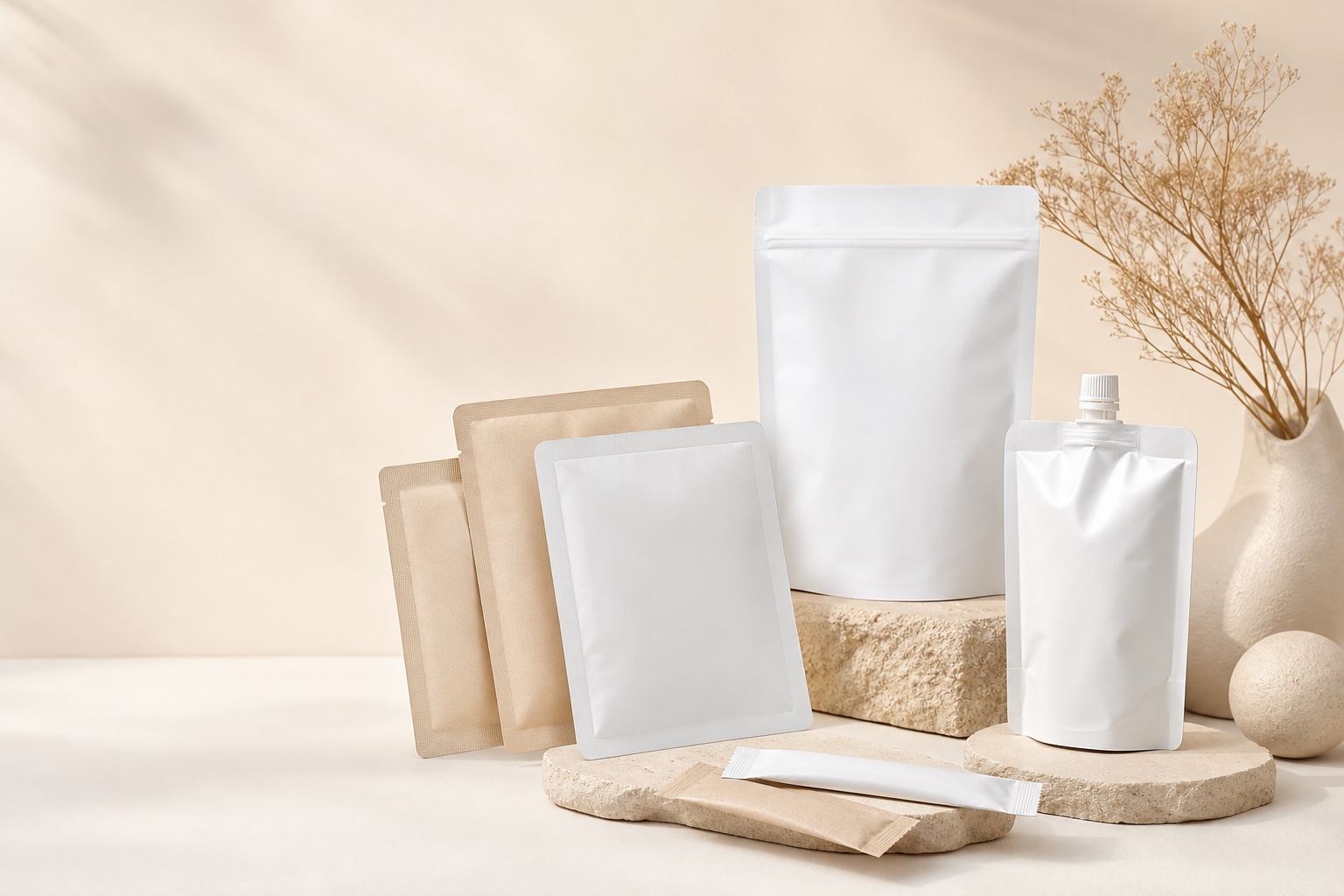
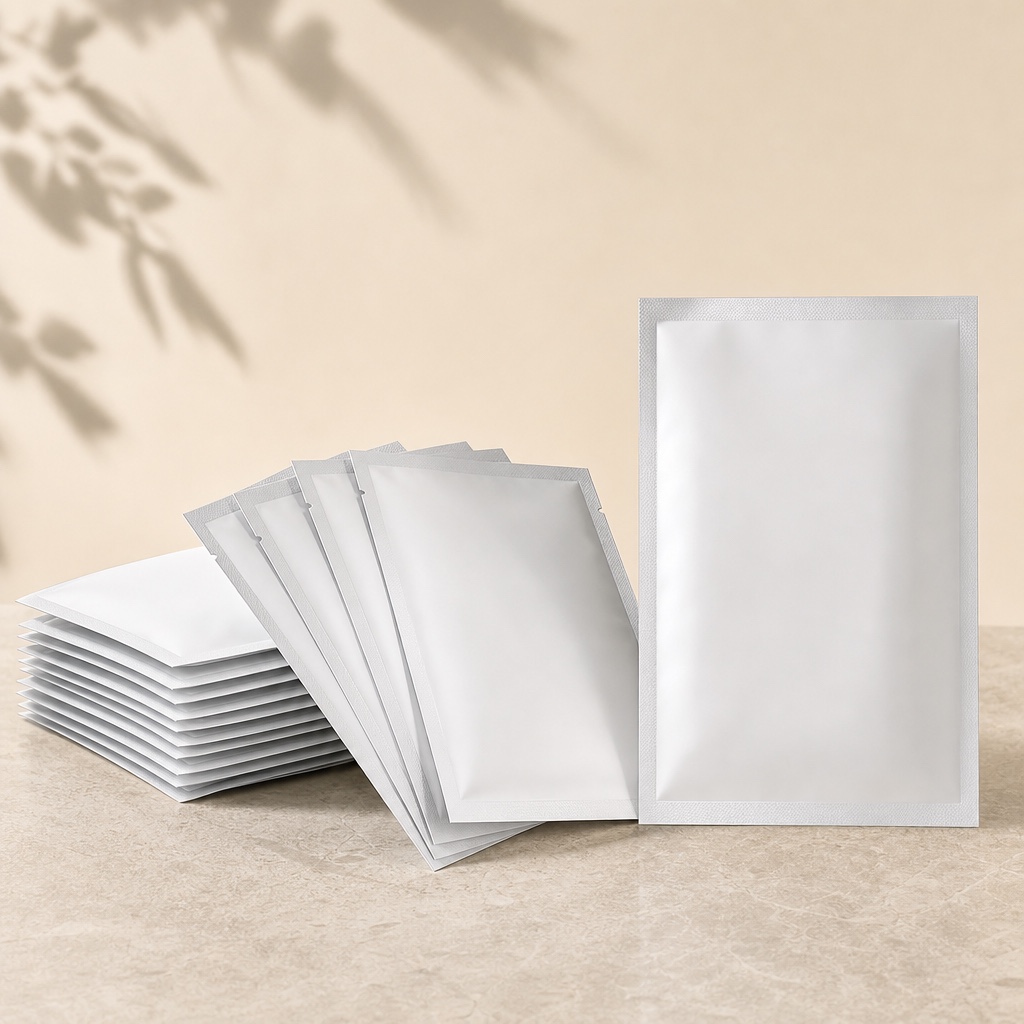
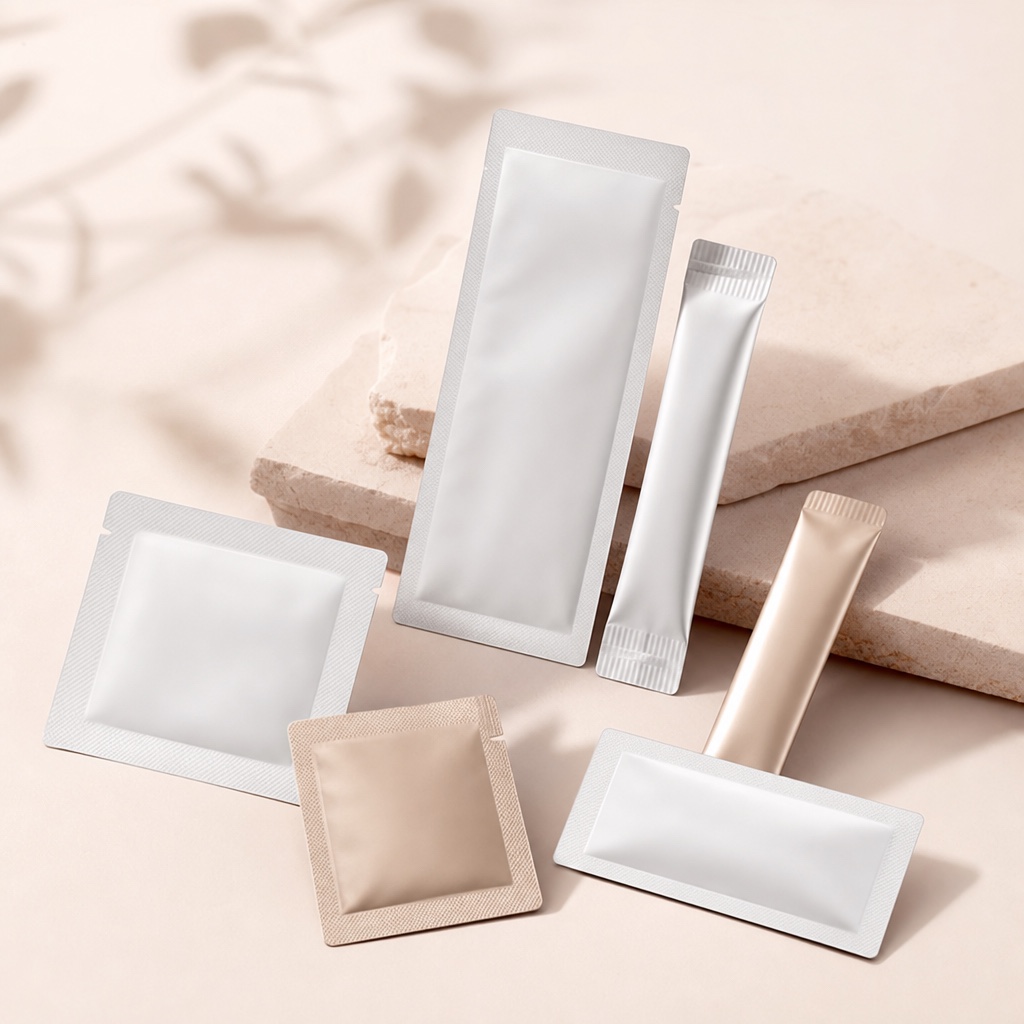
More shelf.
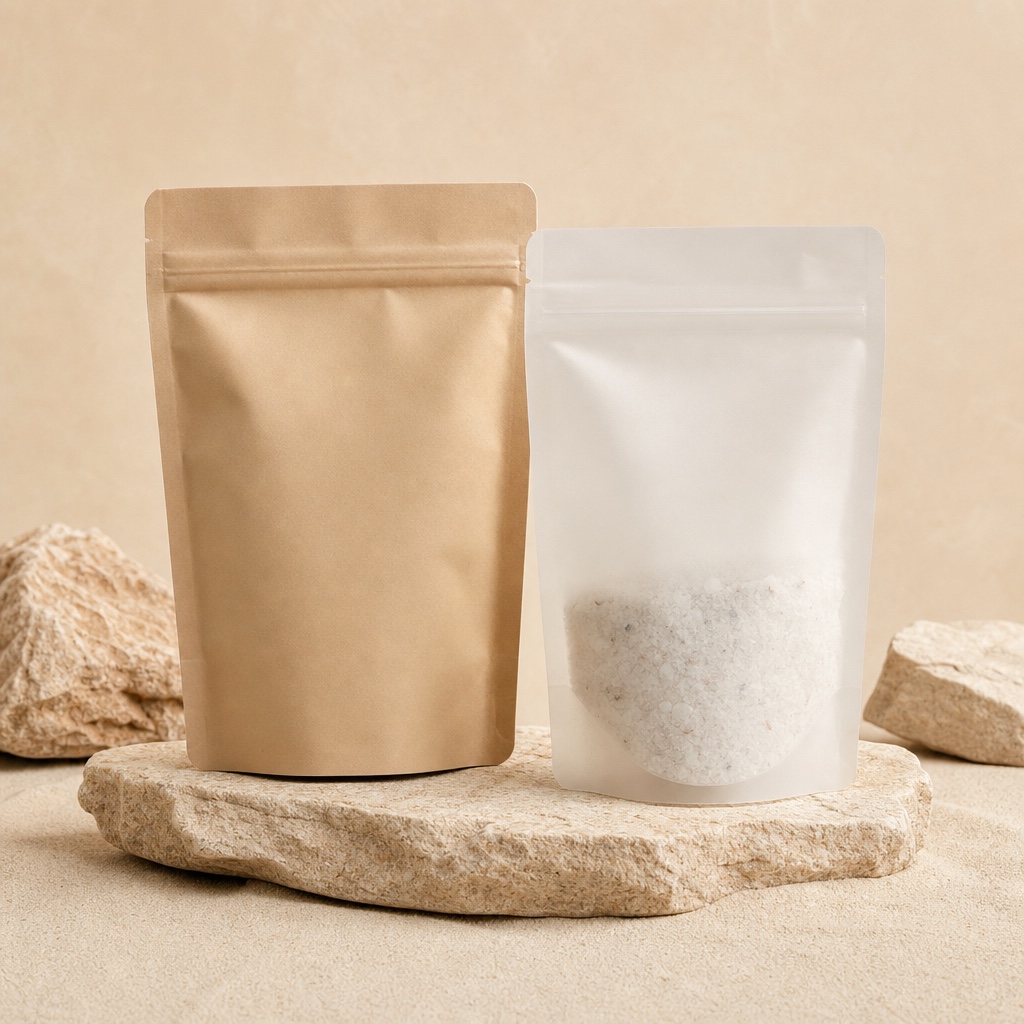
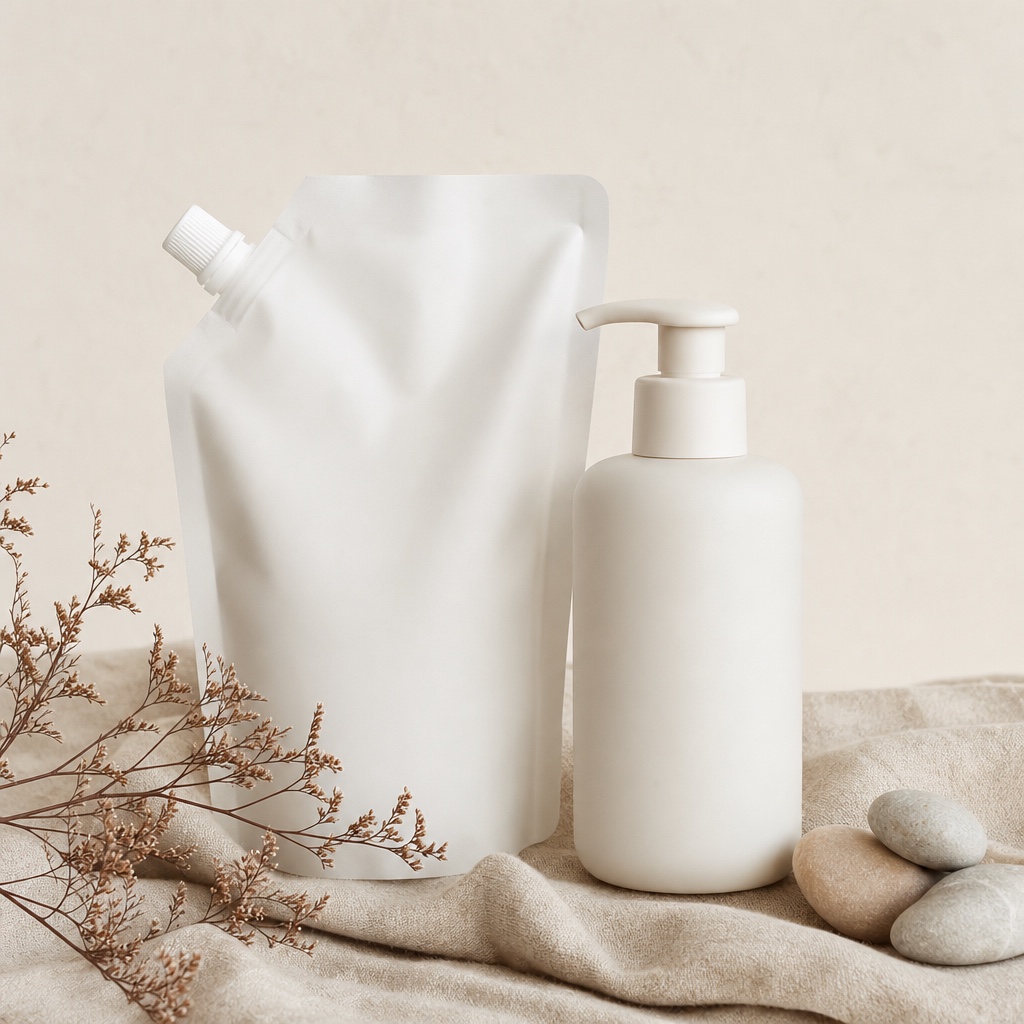
Everything you need to
brief us in one page.
Sachet · Resealable zipper
PCR & kraft-look laminates
Met-PET & clear options for lighter needs
Euro/hang hole · Round corners
Hot stamp · Window patch · Emboss
Bath salt · Powder mask · Wet wipes
GRS / PCR certificate for recycled content
Custom structure / spout tooling: 55–75 days
Six pouch formats cosmetic brands actually use.
The format that sells the sample.
Flexible packaging is where beauty brands win on two fronts at once: it is the lowest-cost, lowest-waste way to package sheet masks and samples, and the sample sachet is the single most powerful customer-acquisition tool a brand has. The catch is barrier and seal integrity — a weak laminate or a bad seal lets serum oxidise or leak, and the consumer blames the product, not the pouch. Vella routes each pouch format to factories with the right film structure and seal validation, and verifies barrier and burst testing before production is approved.
Flexible pouches, with numbers.
A printed sheet-mask pouch (about 4 × 10 cm) carries an industry floor of around 100,000 pieces per design at large converters and around 30,000 at smaller ones, with gravure cylinders at RMB 850–1,500 (≈USD 120–210) per colour and a 15–20 day cycle with ±10% over- or under-run. Pouches on stock film with custom print run 25–35 days; a custom structure or spout tooling 55–75 days. The pass marks are numeric: top seal ≥60 N/15 mm, side seals ≥65 N/15 mm, spout and tube-style seals ≥20 N/cm, and on foil structures oxygen and moisture transmission ≤0.1 per m² per 24 h.
Specification: pouch formats, sizes and structures
| Format | Typical size / fill | Structure | Features | Where it fits |
|---|---|---|---|---|
| Sheet-mask pouch (3-side seal) | About 4 × 10 cm folded mask in a 100–160 mm pouch; 20–30 ml serum | PET / AL / LDPE pure-foil laminate (gravure print on the PET face); VMPET metallised alternative | Tear notch; matte or gloss top film; single-dose | Sheet masks, under-eye patches |
| Sample sachet (flat, 3- or 4-side seal) | 5 × 7 cm (6 g) · 6 × 8 cm (8 g) · 6 × 9 cm (10 g) | PET / AL / PE for barrier; mono-PE for recycle-ready | Tear notch; roll-film for form-fill-seal lines | Serum, lotion, shampoo, cream samples |
| Stick pack | 1–15 ml | PET / AL / PE or PET / VMPET / PE | Vertical form-fill-seal | Single-dose serum, ampoule alternative |
| Stand-up pouch (doypack) | 50–500 g | PET / PE, kraft / PE, mono-PE, PCR laminate | Bottom gusset; resealable zipper; hang hole | Bath salts, scrubs, powder masks, solid refills |
| Spout pouch | 100–1,000 ml | PET / PE or mono-PE laminate; barrier layer where needed | Spout and screw cap sized to pour into the bottle neck | Shampoo, body wash, lotion, hand-wash refills |
| Flat-bottom pouch | 100–500 g | Kraft / PE, PET / PE, mono-PP | Box-like base; zipper; window patch | Powder, granules, solid bars |
| Wet-wipe pack | 10–80 wipes | PET / PE with resealable label or flip lid | Peel-and-reseal label | Cleansing and make-up remover wipes |
Barrier structures: what each film actually blocks
| Structure | Oxygen / moisture barrier | Recycle status | Cost position | Use it for |
|---|---|---|---|---|
| PET / AL / LDPE (pure aluminium foil) | OTR ≤0.1 cc/m²·24 h; WVTR ≤0.1 g/m²·24 h (mask-pouch standard, GB/T 1038 / 1037) | Multi-material; not kerbside-recyclable | About 30% higher unit price than metallised | Sheet masks, serums, anything light- or oxygen-sensitive |
| PET / VMPET / PE (metallised) | Good, below foil; pinholes matter | Multi-material | Baseline foil-look pouch | Samples, wipes, powders |
| PET / EVOH / PE (PBL-type, foil-free) | High: EVOH passes oxygen at roughly 0.2 units versus 150–300 for single-layer PE (tube data) | Foil-free, metal-detectable | Mid | Oil- or fragrance-led formulas that want a squeeze-back, foil-free look |
| Mono-PE or mono-PP laminate | Light: OTR in the 150–300 range for PE | Recycle-ready where the market stream accepts it | Baseline | Refill spout pouches, doypacks for wash-off products |
| Kraft / PE or kraft / VMPET / PE | Light to medium | Multi-material unless mono-PE with a paper look | Baseline to mid | Powders, bath salts, natural positioning |
Indicative MOQ, plates and lead time (partner-factory practice)
| Route | Realistic minimum | Set-up cost | Factory-gate lead time |
|---|---|---|---|
| Printed sheet-mask pouch, 4 × 10 cm, large converter | Around 100,000 pieces per design | Gravure cylinders RMB 850–1,500 (≈USD 120–210) per colour; text-only artwork can use line plates | 15–20 days including plate making; ±10% over/under is normal |
| Printed sheet-mask pouch, smaller converter | Around 30,000 pieces per design | Same cylinder cost | 15–20 days |
| Printed roll film for your own form-fill-seal line | From about 100 kg (≈RMB 45/kg printed); unprinted from 30–50 kg (≈RMB 38/kg) | Cylinders per colour | 15–20 days; needs a dedicated filling machine |
| Stock film, custom print (sachet, stand-up, spout) | Set by the print run on stock film | Cylinders or plates +5–7 days on new artwork | 25–35 days door to factory gate |
| Custom structure or spout tooling | Quoted per structure | Spout fitment tool typical partner-factory range USD 2,000–6,000 | 55–75 days |
| Digital-print short run (simple sachets, sleeves) | About 100–500 | None | 10–15 days |
| Folding carton to hold the pouches | 2,000–5,000 | Cutting die, low cost | 10–15 days after artwork approval |
QC thresholds for pouches and sachets
| Test | Method / standard | Pass threshold |
|---|---|---|
| Heat-seal strength — top seal | QB/T 2358 peel | ≥60 N/15 mm |
| Heat-seal strength — side seals | QB/T 2358 peel | ≥65 N/15 mm |
| Spout-pouch and tube-style seals | Heat-seal peel | ≥20 N/cm; seal width 3.5–4.5 mm; seal line variation ≤0.5 mm |
| Tensile strength / elongation | GB/T 1040.3 | ≥50 N/15 mm; break force ≥50 N; elongation ≥77% |
| Interlayer peel (delamination) | GB/T 8808 | BOPP/AL ≥0.5 N/15 mm; AL/PE ≥2.5 N/15 mm |
| Compression | Filled to net content, 200 N for 10 min | No burst, no leak |
| Vacuum seal | Filled with water, −0.06 MPa for 1 min | No leakage |
| Barrier | GB/T 1037 (WVTR), GB/T 1038 (OTR) | ≤0.1 g/m²·24 h; ≤0.1 cc/m²·24 h on foil structures |
| Solvent residue | GB/T 10004 | ≤10 mg/m² |
| Cold / heat / light | 30 ml of bulk sealed in; −10°C (or −18°C) 7 days; 50°C 7 days; light-ageing cabinet 7 days | No visible change against the control |
| Thickness | Micrometer, 0.001 mm | Total laminate within ±8% of the standard sample |
| Print register and position | Steel rule, 0.5 mm | Main image ≤0.3 mm, other ≤0.5 mm; position ±2 mm; barcode grade C or better |
| Microbiology (irradiated lots) | Plate count | Total bacteria ≤10 CFU/g; yeast and mould ≤10 CFU/g; irradiation certificate per batch |
| Heavy metals (contact layer) | Third-party laboratory | Pb + Cd + Hg + Cr(VI) ≤100 ppm |
| Acceptance | ISO 2859-1 | AQL agreed per defect class |
Compatibility: which formula goes in which structure
| Formula | Recommended structure | Hard rule |
|---|---|---|
| Sheet-mask serum (water-based, often with actives) | PET / AL / LDPE pure foil | Foil for light and oxygen; irradiated lots need the certificate |
| Serum with vitamin C, retinol | Foil, or PET / EVOH / PE | Needs the barrier: EVOH ~0.2 versus 150–300 for PE |
| Toner or mist above ~30% ethanol | Foil laminate with PE sealant; test the sealant | Never a PET contact layer for the bulk — PE sealant inside |
| Facial oil, essential oils | Foil with a PE sealant; check ink and adhesive | Essential oils extract plasticisers and lift ordinary inks — run the 48°C / 30-day test |
| Shampoo, body wash, lotion refills | Mono-PE spout pouch | Spout sized to the bottle neck; seal and burst on sample batches |
| Powders, bath salts | Stand-up or flat-bottom, kraft / PE or mono-PP with zipper | Moisture seal; WVTR matters more than OTR |
| Wet wipes (alcohol or fragrance) | PET / PE with resealable label | Check the label adhesive against the lotion |
Print and finish × indicative MOQ
| Process | Suits | Indicative floor | Note |
|---|---|---|---|
| Rotogravure (up to 8–10 colours) | All laminates | Set by cylinder cost — 30,000–100,000 mask pouches; stock-film runs lower | Cylinders RMB 850–1,500 per colour; best colour and metallic effect |
| Digital print | Simple sachets, sleeves, short runs | ~100–500 | No cylinders; lower colour saturation |
| Matte / soft-touch top film | PET or BOPP outer | No extra floor | Specify light- or matte-face film at the structure stage |
| Hot stamp on pouch | Flat panels | Small die | Foil 12–25 µm; ≤2 passes with print |
| Window patch, emboss | Stand-up and flat-bottom | Adds set-up | Window breaks the barrier unless a barrier window film is used |
| Pressure-sensitive label on a plain pouch | Any | From ~500 | The cost-saving route below the print-run floor |
Six-module program for flexible packaging and pouches
| Module | What we do for this product | Deliverable |
|---|---|---|
| 1 · Spec | Fix format, size, structure (foil, metallised, EVOH or mono-material), sealant, notch, zipper or spout, print method and the test thresholds above | Packaging Spec Sheet |
| 2 · Source | Route mask pouches, sachets, spout pouches and roll film to converters matched to your run size — 30k versus 100k floors — with cylinder costs itemised | Quote + Supplier Options |
| 3 · Sample | Stock-film samples, then printed samples; seal, burst and barrier report; 48°C / 30-day contact test with your bulk | Golden Sample + Compatibility Report |
| 4 · Mould | Spout or fitment tool only where a custom fitment is justified; cylinders held for reorders | Mould Ownership Agreement |
| 5 · QC | IQC on film lots, in-process seal and register checks, OQC to agreed AQL; irradiation certificate for mask pouches | Inspection Report |
| 6 · Ship | Ten-node calendar with ×1.3 buffer and CNY +15 days; cartons at ≤8% moisture, pouches flat-packed with a moisture barrier | Production Calendar + Packing Standard |
Barrier data for foil, EVOH and mono-PE structures is tabulated on cosmetic tube specifications, and the formula rules on the compatibility matrix. Refill spout pouches for wash-off products sit in the haircare and bodycare solution; sachets and mask pouches for treatment lines in the skincare solution. The test battery is on cosmetic packaging quality standards; supplier screening on how to evaluate a China packaging supplier. Sibling formats: cosmetic tubes, HDPE shampoo bottles and refillable packaging.
Related standards: lead time and production calendar · decoration process comparison · export packing and transit standards · sustainable and refill packaging · all engineering references
Four things that decide whether a pouch performs.
A pouch looks simple, but the things that fail are invisible until they fail — barrier, seal, leak and recyclability. We test for them before production, not after.
Barrier structure
Sheet-mask serum and active formulas oxidise without the right barrier. We match the film structure — aluminium-foil, metallised PET or transparent high-barrier — to your formula's oxygen and light sensitivity, not to whatever the factory runs by default.
Seal & burst integrity
A pouch is only as good as its weakest seal. We require seal-strength and burst testing on sample batches so a pouch survives filling, shipping and the consumer's hands without leaking.
Fill & format match
Powders, scrubs, thin serums and thick lotions each need a different pouch style, gusset and closure. We spec the format to your fill and filling line — including spout and fitment compatibility — before tooling.
Recyclability that's real
A "recyclable" pouch with a mixed aluminium laminate isn't recyclable. Where you need a recycle-ready claim, we route to mono-material PE or PP structures and verify the full laminate is compatible before approving production.
Frequently asked about pouches & sachets.
Often paired with pouches.

Read before you brief us.
- Foil vs Clear Laminate for a Sheet Mask Pouch: Barrier, MOQ and Seal Strength
- Refill Pouch vs Inner Cartridge vs Jar Pod: Which Refill Format Is Cheapest to Launch?
- Sheet Mask Pouch MOQ from China: Why Foil Is 100,000 and How to Get 30,000
- Spout Pouch Refills for Cosmetics: MOQ, Fitment Tooling and Seal Tests
Not sure what to specify? Use the Packaging Spec Builder — formula, volume, quantity and launch date in, a 12-line spec sheet with MOQ verdict and order-by date out.
Tell us what you need,
we'll find it.
Send a brief — pouch style, fill type, quantity, finish — and we'll come back with factory options, material recommendations and an indicative price within 24 hours.