Every last drop.
Everything you need to
brief us in one page.
Lengths to match fill volume
Custom volumes available
ABL/PBL laminate · PCR mono-material
Roller-ball · Spatula · Brush applicator
Pearlescent · Soft-touch laminate
Digital print for short runs
MDPE recyclable · HOD recyclable
Custom laminate: 60–80 days
Hygienic, light,
and endlessly adaptable.
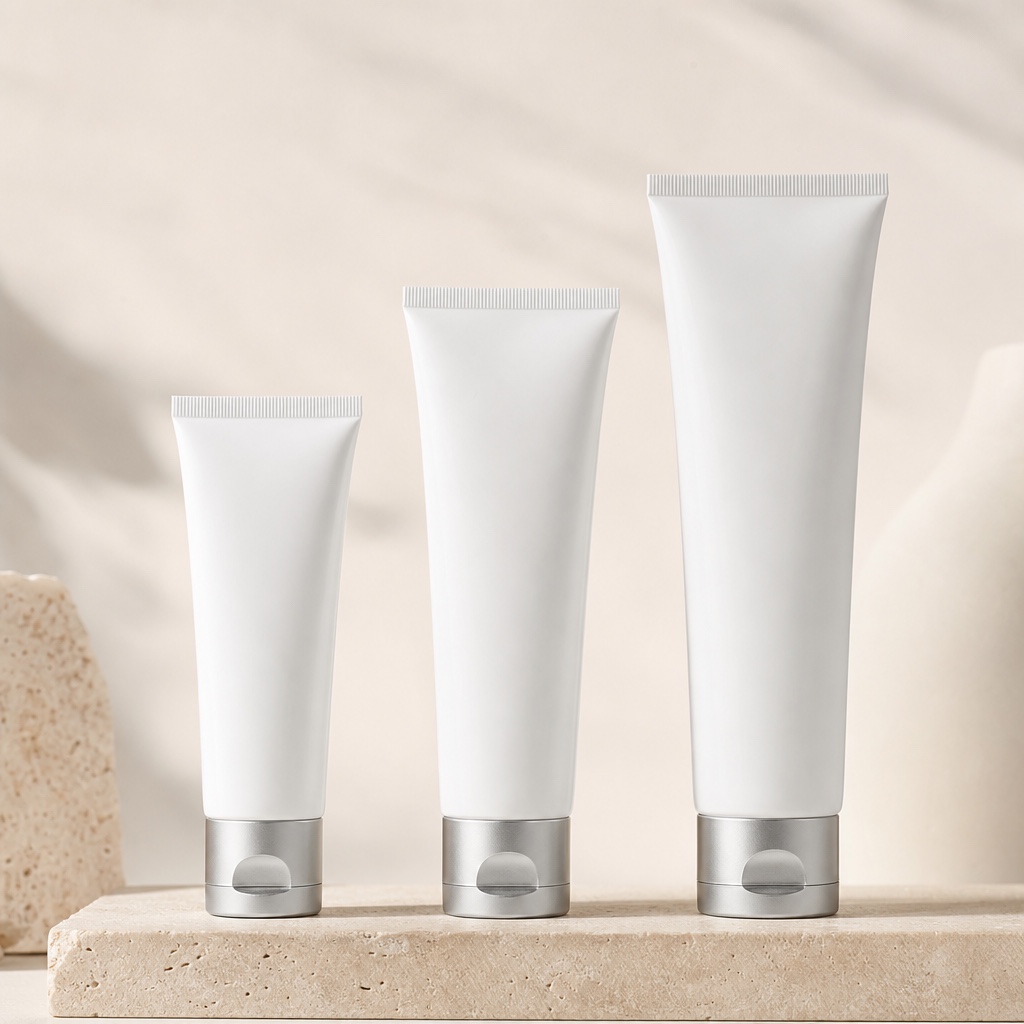
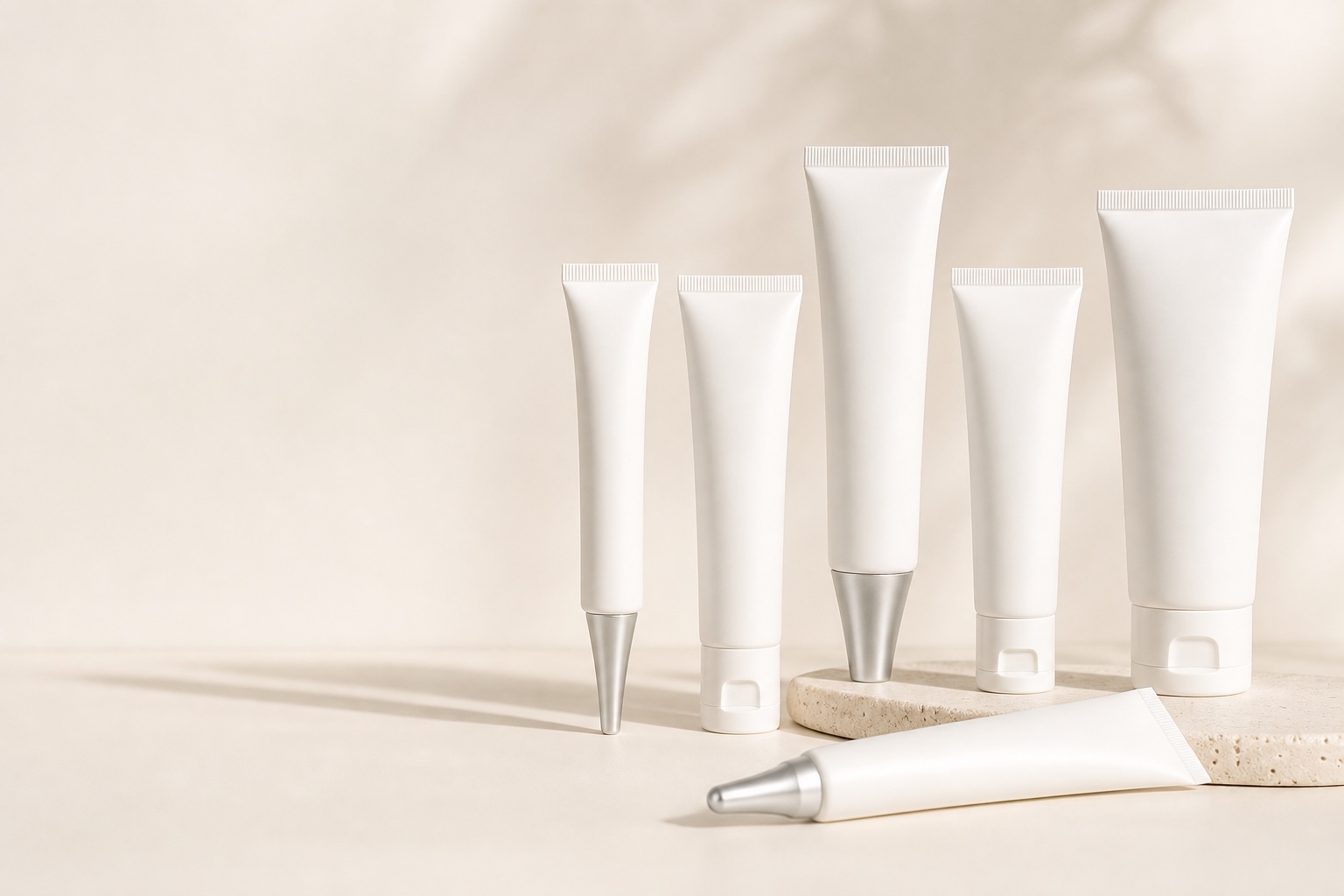
Tubes are the most versatile cosmetic format — they protect formula integrity better than open jars, ship lighter than glass, and offer more decoration surface than most bottles. The applicator choice (standard nozzle, precision tip, roller-ball, spatula) changes the product positioning entirely. We help you spec tube format, applicator and decoration together.
Cosmetic tubes, with numbers.
Custom printed cosmetic tubes from China carry an industry MOQ floor of 5,000–10,000 tubes per SKU (large factories hold at 10,000; 3,000 is sometimes negotiable on a stock body), printing plates of RMB 200–300 ≈ USD 30–45 per design, a lead time of 15–20 days from sample-tube approval, and a ±10% over/under delivery tolerance invoiced on delivered quantity. Barrier is the other number that matters: a five-layer EVOH co-extruded tube has an oxygen transmission rate of 0.2–1.2 units against 150–300 for single-layer PE. These are the figures we negotiate against with vetted partner factories operating to ISO 22716 / GMP — indicative, not a single fixed promise.
Specification: diameter, fill and structure
| Diameter | Typical fill | Typical products | Structures available |
|---|---|---|---|
| Ø13 · Ø16 · Ø19 | 3–15 g | Samples, eye cream, lip treatment, serum minis | Single-layer PE; 5-layer EVOH co-ex |
| Ø22 · Ø25 | 15–40 g | Eye and face cream, travel sizes, hand cream | Single-layer PE; 5-layer EVOH co-ex; PBL |
| Ø28 · Ø30 · Ø33 · Ø35 | 30–100 g | Face cream, cleanser, sunscreen, hand cream, primer | Single-layer PE; 5-layer EVOH; ABL; PBL |
| Ø38 · Ø40 · Ø45 | 80–150 g | Cleanser, mask, hair treatment, body cream | Single-layer PE; 5-layer EVOH; PBL |
| Ø50 · Ø55 · Ø60 | 150–250 g | Body lotion, shampoo, conditioner, shower gel | Single-layer PE; PCR-PE 30–100% |
| End seal | Straight, angled, umbrella, shaped | Seal width 3.5–4.5 mm; batch code can be embossed in the seal | Tail-fill (open end) or head-fill — state hot-fill or ambient |
| Caps | Screw (single/double-wall), flip-top, nozzle, flat-top, dome, lipstick-style, plug | Nozzle and lipstick-style caps normally include an inner plug | Injection-moulded from stock moulds; most tube factories buy caps from a second supplier |
Printable area by tube diameter (mm, flat template)
| Tube diameter | Front centre | Unwrapped centre | Back centre | Total unwrapped length |
|---|---|---|---|---|
| Ø13 | 10.00 | 20.00 | 30.00 | 40.00 |
| Ø16 | 12.40 | 24.80 | 37.20 | 49.60 |
| Ø19 | 14.65 | 29.30 | 43.95 | 58.50 |
| Ø22 | 17.00 | 34.00 | 51.00 | 68.00 |
| Ø25 | 19.40 | 38.80 | 58.20 | 77.60 |
| Ø30 | 23.25 | 46.50 | 69.75 | 93.00 |
| Ø35 | 27.25 | 54.50 | 81.75 | 109.00 |
| Ø40 | 31.00 | 62.00 | 93.00 | 124.00 |
| Ø45 | 34.90 | 69.80 | 104.70 | 139.60 |
| Ø50 | 38.90 | 77.80 | 116.70 | 155.60 |
| Ø60 | 46.50 | 93.00 | 139.60 | 186.00 |
MOQ, plates and lead time by route
| Route | Indicative MOQ | Tooling / set-up | Lead time (factory gate) |
|---|---|---|---|
| Stock tube body + stock cap, printed | 5,000–10,000 per SKU (industry floor; large factories 10,000; 3,000 sometimes negotiable) | Printing plates RMB 200–300 ≈ USD 30–45 per design; no mould | 15–20 days from sample-tube approval |
| Stock tube + hot-stamp or silk-screen accent | Same floor as above | Hot-stamp charged by foil area; silk-screen costs more and fewer factories run it | 15–20 days + 5–7 days for the extra process |
| Stock tube + sprayed or metallised cap | Cap spray 2,000–5,000; electroplated cap ~10,000 | Fixtures and colour matching only | Add 5–20 days for the outsourced cap process |
| Private-mould cap (special shape) | 3,000–10,000 plus tooling | Closure tooling roughly USD 3,000–10,000; quotes vary ~3× between toolmakers | 45–60 days mould only; 90–120 days brief-to-mass-production |
| Delivery tolerance | ±10% over/under on every route | Industry-wide; invoiced on delivered quantity | Plan fill quantities on the low side |
| Calendar buffer | — | Quoted cycle × 1.3; +15 days across Chinese New Year | Sea freight 18–35 days port to port; air 3–7 |
QC thresholds a tube order is checked against
| Test | Method | Typical pass threshold |
|---|---|---|
| End-seal strength | Heat-seal peel | ≥20 N/cm; seal width 3.5–4.5 mm, centred within ±1 mm |
| Pressure burst / loaded seal | Air gun; filled tube between plates | 0.15 MPa for 3 s no burst; 10 kg for 5 min no leak |
| Crush resistance | Plate load 3 s | 10 kgf (Ø under 25 mm) or 15 kgf (Ø over 25 mm), no rupture |
| Flip-top hinge | Cycling | 200 opens plus twist ±30° twice, no fracture |
| Cap torque | Torque meter | ≤10 kgf·cm application without thread damage; cap-to-shoulder gap ≤0.8 mm; inner-plug retention 0.5–1.2 kgf |
| Dimensions / weight | Calliper, balance at 20°C | Diameter ±0.5 mm, length ±1.5 mm, wall ±0.05 mm; weight ±10%, brim capacity ±5% |
| Print registration | Gauge | ≤±1.5 mm (≥100 ml) or ≤±1 mm (smaller) |
| Thermal cycling | Oven / freezer | 48°C and −15°C, 48 h each; ≥20 tubes sampled per 10 lots |
| Compatibility | Actual bulk at 48°C, RH 75% | 30 days: no colour, odour, swelling or surface change |
| Vacuum leak (quick) | 9/10 filled, cap at 0.6–1.2 N·m | −0.05 to −0.06 MPa for 3 min, then inverted 24 h, no leak; full test −0.08 MPa 15 min, loss ≤0.5% |
| Decoration adhesion | 3M 600 tape over print, 10 passes, pulled at 45° | No lift; 75% alcohol soak 30 min, no coating loss |
| Heavy metals / hygiene | Third-party lab | Pb+Cd+Hg+Cr(VI) ≤100 ppm; TVC ≤10 cfu, pathogens not detected |
| Acceptance | ISO 2859-1 general level II | AQL 0 critical / 1.0–1.5 major / 2.5–4.0 minor; colour at ΔE under D65 |
Which tube structure for which formula
| Formula condition | Rule | Why |
|---|---|---|
| Hand cream, body lotion, cleanser, plain conditioner | Single-layer PE co-extruded | OTR 150–300 units is acceptable when barrier does not matter and print does |
| Vitamin C, retinol, whitening, peptides | 5-layer PE / tie / EVOH 15–20 µm / tie / PE | OTR 0.2–1.2 units — about two orders of magnitude lower than mono PE |
| Essential oils, ester-rich fragrance, mildly corrosive bulks | 5-layer EVOH co-ex or ABL (12 µm or 9 µm foil) | Ethanol weight loss tens of times lower than single layer; ABL for the strongest solvent load |
| Sunscreen and easily oxidised emulsions | ABL or 5-layer EVOH; PP/PE contact only | Oil-rich SPF bulks attack AS and craze PMMA — keep acrylic off the contact path |
| Fluoride toothpaste | ABL — mandatory | Fluoride ions permeate and corrode plastic barrier layers |
| Ethanol above ~30% | EVOH co-ex with alcohol-rated cap gasket; test the cap plug | Standard gaskets and PET components soften; specify ethanol resistance |
| Recycled-content claim | PCR-PE mono-material 30–100%; GRS or equivalent certificate per lot | Base tone runs grey/beige and shifts by lot — mid and dark colours hide it |
Decoration process × indicative MOQ for tubes
| Process | Set-up that drives the minimum | Indicative MOQ | Notes |
|---|---|---|---|
| Offset / flexo body print | Plates RMB 200–300 ≈ USD 30–45 per design | Follows the tube floor 5,000–10,000 | Up to 8 spot or 4-colour process; eye-mark position set by the factory template |
| Silk-screen | Screen per colour | ~2,000 on stock components | Fewer tube factories run it; UV-cured |
| Hot stamping | Foil plate, charged by area | Small one-off | Flat or gentle curves; ≤2 passes with screen print |
| Sprayed / soft-touch cap | Spray line set up for your tone | 2,000–5,000 | Adhesion checked with 3M 810 cross-hatch |
| Electroplated / metallised cap | Plating line configured per tone | ~10,000 | No nickel on skin contact; plated parts never touch the bulk |
| Label / shrink sleeve | Digital print | ~100–500 | Full colour on a stock tube; change artwork between batches |
Most tube problems are visible before production if the right test is run on the right sample. The table below lists the failures we see most often on tube programmes, where each one is caught in the four inspection gates, and the threshold that catches it.
Common tube failure modes and where they are caught
| Failure | Root cause | Caught at | Threshold that catches it |
|---|---|---|---|
| End seal opens on the filling line | Tail-fill nozzle too close to the seal area; seal width under 3.5 mm; hot-fill not declared | IPQC on first-article | Seal ≥20 N/cm; 10 kg for 5 min between plates |
| Vitamin C or retinol cream browns in 3 months | Single-layer PE specified for an oxygen-sensitive bulk | Spec, before sourcing | 5-layer EVOH, OTR 0.2–1.2 vs 150–300 |
| Essential-oil tube smells through the wall | Mono PE for an aroma-led formula; cap plug not tested | Sample, 48°C / 30 days | Ethanol weight loss tens of times lower on co-ex; ABL where solvent load is high |
| Print drifts around the tube | Eye-mark placed by the designer, not the factory template; shrinkage in heated steps not allowed for | Artwork check and FQC | Registration ≤±1.5 mm (≥100 ml) or ≤±1 mm |
| Cap and tube shoulder do not match | Cap from a second supplier quoted on the tube drawing, not the neck drawing | IQC on caps | Cap-to-shoulder gap ≤0.8 mm; torque ≤10 kgf·cm without thread damage |
| Quantity short at delivery | ±10% industry tolerance not planned into the fill order | Order review | Delivery ±10%, invoiced on delivered quantity |
| PCR tube colour differs between lots | PCR base tone shifts by lot; pastel colour chosen | Golden sample and FQC | ΔE under D65; mid and dark tones hide the lot shift |
Six-module program for cosmetic tubes
| Module | What we do for cosmetic tubes | Deliverable |
|---|---|---|
| Spec | Fix diameter and fill together ("Ø35, 80 g"), structure by formula, seal type, cap and filling method | Packaging Spec Sheet |
| Source | Match to partner tube factories already tooled for the diameter; plate and cap quotes itemised | Quote + Supplier Options |
| Sample | Printed proof, sample tubes filled with your bulk, 48°C / 30-day compatibility | Golden Sample + Compatibility Report |
| Mould | Only if a special cap shape is wanted; ownership, custody and transfer written down | Mould Ownership Agreement |
| QC | IQC / IPQC / FQC / OQC against the thresholds above; AQL agreed in advance | Inspection Report |
| Ship | ±10% tolerance planned into fill quantities; carton spec; CNY and Golden Week buffers | Production Calendar + Packing Standard |
The full tube standard — structures, the Ø13–Ø60 print-area table, seals, commercial terms and the QC sheet — is on our cosmetic tube specifications reference. Tubes for treatments and masks at the Ø40–Ø60 end are covered in the haircare and bodycare packaging solution, and face-care tubes in skincare packaging. The inspection gates and thresholds above follow our cosmetic packaging quality standards, and the questions to put to any tube supplier are in how to evaluate a China packaging supplier. Related formats: sunscreen packaging and airless bottles.
Related standards:
Four tube tests most buyers never do until product launch.
A tube that prints well in the sample stage can fail in four ways at scale: burst seal, colour shift under retail lighting, print registration drift, or recycling claim non-compliance. Vella runs all four checks pre-production.
Bottom Seal Burst Test
The heat-sealed bottom of a filled tube is the most common failure point. We apply 30N of squeeze pressure to 20 samples per batch — any seal that opens or oozes fails the batch before it ships.
Colour Accuracy Under D65
Tube print colours look different under warm retail lighting vs standard D65 (daylight) conditions. We approve colour under D65 light before production, then recheck a production sample under the same conditions.
Print Registration
Flexo printing on tubes requires consistent registration across a curved surface. We check print position for all 20 label edges and corners — no bleed, no shift, consistent across 50+ sample units.
PCR Content Certification
For PCR tubes, the recycled content claim must be backed by a third-party certificate from the resin supplier — not a factory declaration. We require the certificate before approving any PCR tube for production.
Frequently asked about cosmetic tubes.
Often ordered alongside cosmetic tubes.
Read before you brief us.
- Airless vs Tube for Sunscreen: Dose, UV Protection, Cost and MOQ
- EVOH, ABL or PBL: Which Cosmetic Tube Barrier Do You Need for Retinol, Acids and Essential Oils?
- Custom Printed Cosmetic Tube MOQ and Plate Cost from China (2026)
- Cosmetic Tube Print Area by Diameter (Ø13–Ø60): How Much Artwork Fits
- Lip Gloss Tube and Wand MOQ from China: Stock, Decorated and Private Mould
- Mascara Tubes and Wands: Components, Wiper Fit, MOQ and Sourcing from China
Not sure what to specify? Use the Packaging Spec Builder — formula, volume, quantity and launch date in, a 12-line spec sheet with MOQ verdict and order-by date out.
Tell us what you need,
we'll find it.
Send a brief — format, size, quantity, finish — and we'll come back with factory options, material recommendations and an indicative price within 24 hours.
Three things worth reading first.
- What eight China suppliers actually publish as their minimum order quantity — Dalica, Boyu, Gidea PAC, Topfeel Pack, UKPACK, Lisson, JingSourcing and Vella side by side, each figure quoted from that company’s own page. The published industry floor is 5,000–10,000 pieces per item, and this explains what moves it.
- Why a matched collection across bottles, jars and tubes is harder than it looks — a spray minimum attaches to the shape, not the colour, so six formats in one colour is six set-ups rather than one. Plus why two “white” components from the same brief can still fail to match.
- Sourcing partner, factory or trading company — which do you actually need? — eight questions that reveal which model a supplier really belongs to, including the honest case against using a sourcing partner at all.