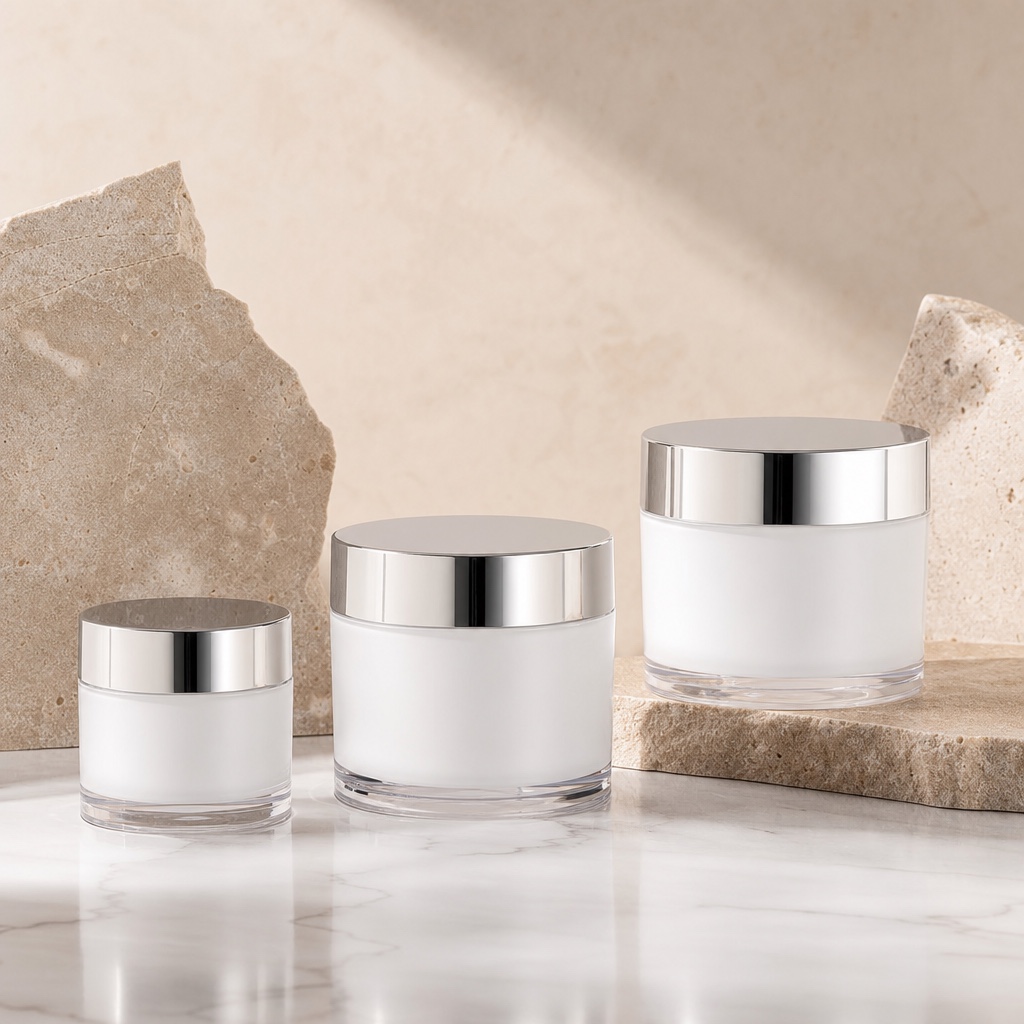
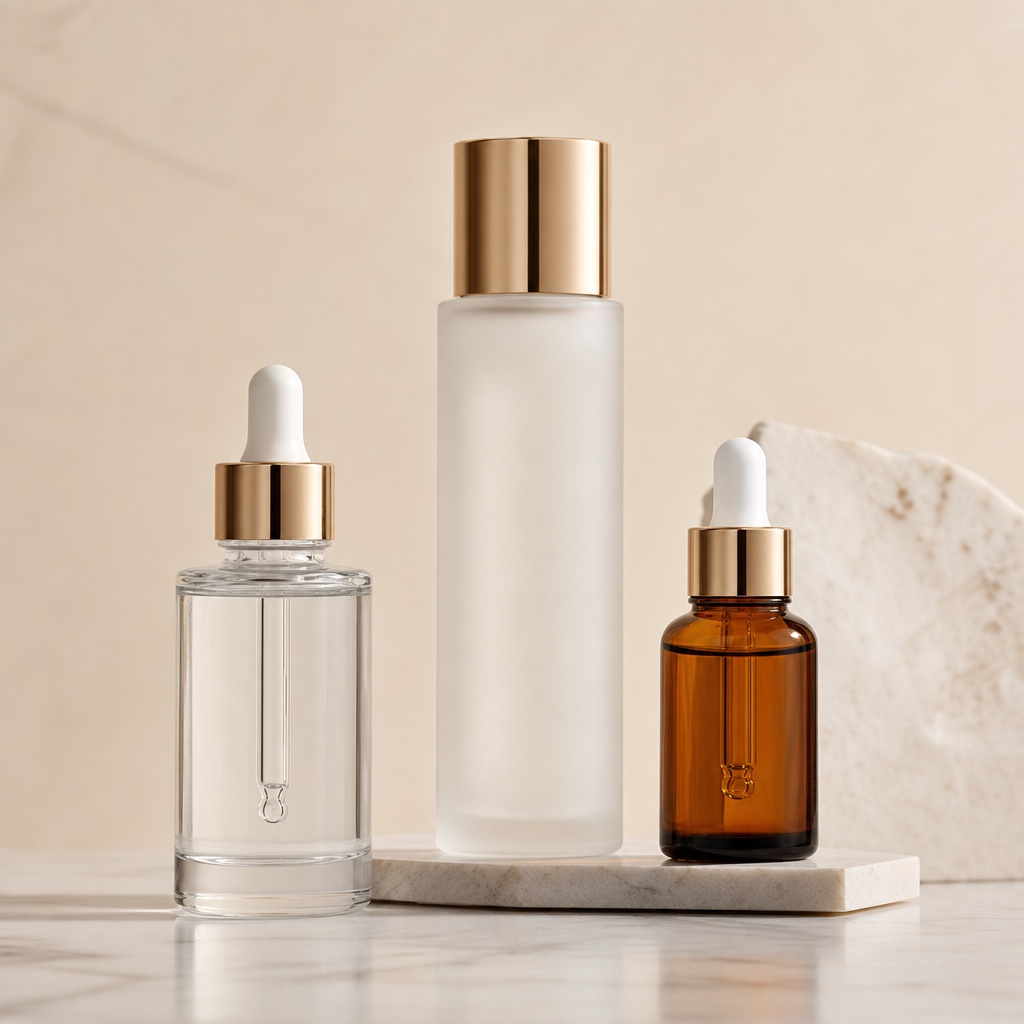
Seamless finish.
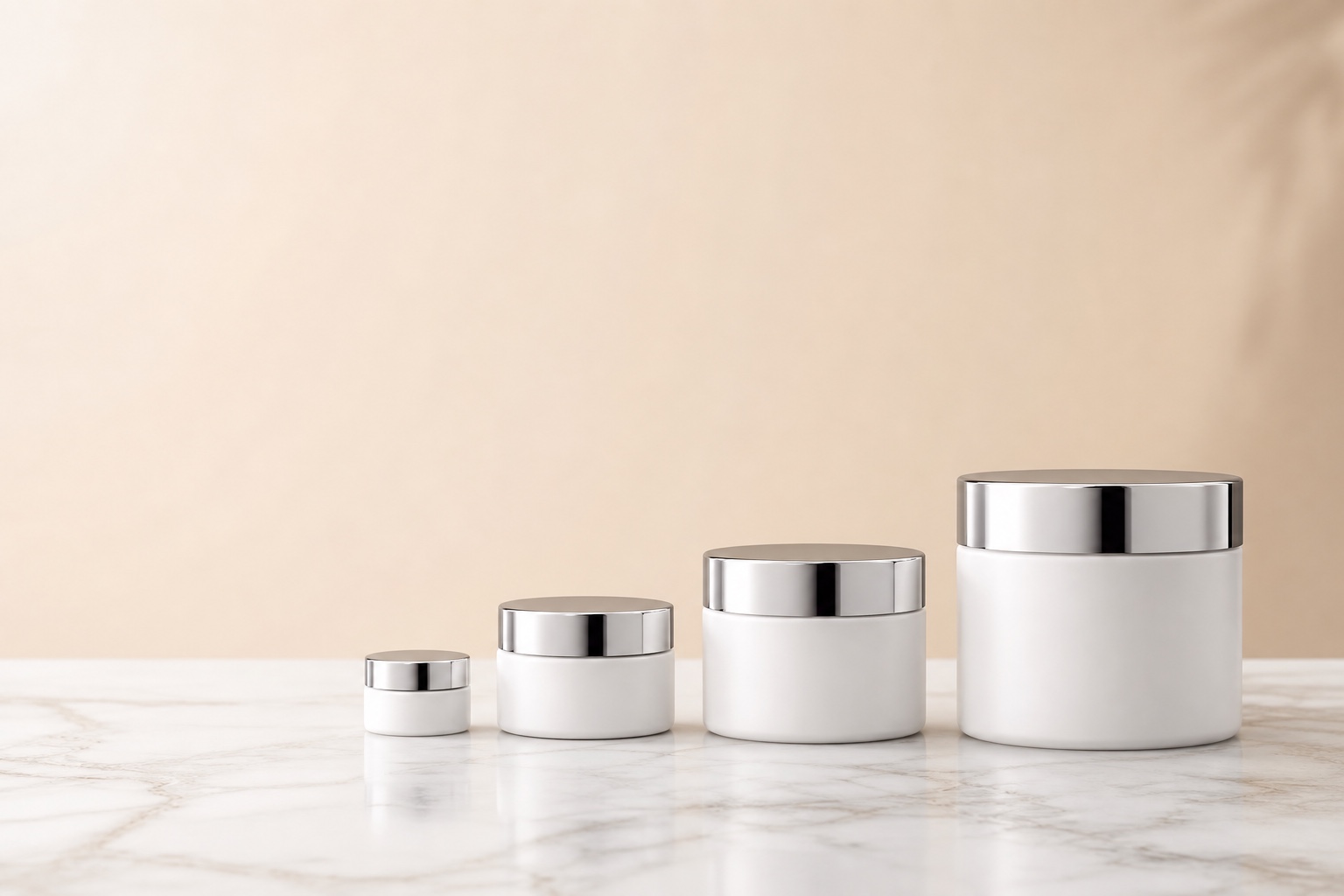
Everything you need to
brief us in one page.
200–250 ml is the popular supplement size
weighted base for a luxury hand-feel
Anti-fingerprint coating recommended
for extra weight · wide-mouth screw neck
Desiccant-compatible for capsules/powder
SGS & FDA · ISO-certified manufacturing
Artwork added when your branding is ready
no tooling · custom mould 70–90 days
Heavy, seamless,
and food-safe.
Glass is inert and food-safe, so the interior is ideal for supplement capsules, powder or a treatment cream. The matte black is a soft-touch spray on the exterior only — it never touches the contents — giving you a premium, seamless, minimalist jar with real weight in the hand. Add a weighted base for the luxury feel and an anti-fingerprint layer so the surface stays clean, and you have a jar that reads high-end on any shelf, from wellness to prestige skincare.
Matte black glass jars, with numbers.
A straight-sided wide-mouth glass jar of 30–500 ml on a stock (public) mould needs no tooling; the matte black is an exterior spray coat that adds about RMB 0.5–1.1 (≈USD 0.07–0.15) per jar with a working floor of 2,000–5,000 pieces per shape, screen print adds ≈USD 0.014 per colour from about 2,000, and the factory-gate cycle is 30–40 days for the sprayed run inside a 30–60 day glass window. Made-to-order glass on your own mould carries the furnace floor of 30,000–200,000 pieces with tooling of about RMB 4,000 (≈USD 555) per cavity, which is why this shape is almost always sourced from stock. The coating is signed against a 3M 810 cross-hatch pull and pencil hardness ≥2H, the glass against GB/T 4547 thermal shock and GB 4545 annealing, and food contact against third-party LFGB, SGS or FDA reports for the specific jar and lid — from vetted partner factories operating to ISO 22716 / GMP.
Specification: sizes, necks, wall and true capacity
| Nominal size | Wide-mouth neck (typical) | Wall and weight (typical partner-factory range) | Brim-full vs fill-line | Typical contents |
|---|---|---|---|---|
| 30 ml | Ø43 or Ø48 mm | Thick-wall press-formed, ~3–5 mm wall; ~90–140 g | Brim-full ≈ 40 ml; fill line leaves headspace | Balm, eye cream, treatment cream |
| 50 ml | Ø48 or Ø53 mm | ~3–5 mm wall; ~150–220 g | Brim-full ≈ 60–65 ml | Face cream, hair mask, capsules (small count) |
| 100 ml | Ø53 or Ø63 mm | ~3–5 mm wall; ~220–320 g | Brim-full ≈ 115–125 ml | Body cream, powder, 30–60 capsules |
| 150 ml | Ø63 or Ø70 mm | ~4–6 mm wall; ~300–420 g | Brim-full ≈ 170–185 ml | Collagen or protein powder, bath salts |
| 200–250 ml | Ø70 or Ø83 mm | ~4–6 mm wall; ~380–550 g | Brim-full ≈ 230–290 ml | The popular supplement size; 60–120 capsules |
| 400–500 ml | Ø83, Ø89 or Ø100 mm | ~5–7 mm wall; ~600–900 g | Brim-full ≈ 460–580 ml | Candle vessel, large powders, bath soaks |
MOQ, mould and lead time by route
| Route | Indicative minimum | Tooling | Lead time, factory gate | Buffered (×1.3) |
|---|---|---|---|---|
| Stock jar, clear or stock black, undecorated | From ~500 pcs (warehouse stock); low thousands on a public-mould run | None | 7–10 days if in stock; glass run 30–60 days | 9–13 days / 39–78 days |
| Stock jar + screen print or hot stamp | ~2,000 pcs | Screen ≈RMB 0.1/colour (≈USD 0.014); hot-stamp die ≈RMB 0.4/design (≈USD 0.055) | +5–7 days on the glass cycle | +7–9 days |
| Stock jar + sprayed matte black (this product) | 2,000–5,000 pcs per shape | Colour-matching and fixtures; no mould | 30–40 days after sprayed-sample approval; samples 10–14 days | 39–52 days; +15 days across Chinese New Year |
| Matched lid: sprayed PP or aluminium | 2,000–5,000 sprayed; ~10,000 plated or custom-tone anodised | Spray fixtures; plating set-up | 25–40 days for aluminium | 33–52 days |
| Own jar shape, new glass mould | 30,000–200,000 pcs made-to-order | RMB 2,500 (≈USD 350) hand mould; RMB 4,000 (≈USD 555) per automatic cavity; 4–8 cavity set RMB 16,000–32,000 (≈USD 2,200–4,450) | 45–60 days tooling + 30–60 days glass | Plan a 90–120 day programme |
Decoration process × MOQ on glass jars
| Process | Set-up that drives the minimum | Realistic minimum | Indicative add-on |
|---|---|---|---|
| Spray coating, matte black (opaque, soft-touch, anti-fingerprint top coat) | Spray line set up, run and cleaned down for your tone; 7-step pre-treatment; 20 min dry | 2,000–5,000 per shape | RMB 0.5–1.1 per jar (≈USD 0.07–0.15) |
| Screen print (logo, text) | A screen per colour; cylinder counts as one colour | ~2,000 | RMB 0.1 per colour (≈USD 0.014) |
| Hot stamp (gold, silver, colour foil) | A die, cut once; ≤2 passes combined with screen print | Small one-off | RMB 0.4 per design (≈USD 0.055) |
| Frosting (acid-etch) under a tinted spray | Etch pass; frost stops below the thread | Moderate; with the sprayed run | Per jar, by size |
| Electroplated or metallised lid | Plating line for your tone; ~6 h metallising cycle | ~10,000 | Medium to high; exterior only |
| Pressure-sensitive label | Print run only | ~500 | Lowest route; full-colour artwork on a stock jar |
QC thresholds a matte black jar is signed against
| Test | Method | Pass threshold |
|---|---|---|
| Coating adhesion | 3M 810 tape over a 2 mm cross-hatch, pressed 10 passes, pulled at 45° | No lift; cross-hatch grade 1 or better (GB/T 9286) |
| Coating hardness and rub | Pencil hardness GB/T 6739; 75% alcohol cloth, one pass | ≥2H; soiling removed without damaging the finish |
| Colour migration of decoration | Decorated jar in 75% ethanol at 48°C for 12 h | No colour into the solvent; no lifting or softening |
| Coating film | Visual under 500–550 lux at 30–35 cm, 45° ± 15°, ≤12 s per piece | None of the 16 named defects: pinholes, orange peel, sagging, cissing, blistering, peeling and the rest |
| Seal (colour-water) | 3/4 filled with dyed water, lying and inverted, −0.06 MPa for 5 min | No dye outside the seal area |
| Vacuum leak (volatile contents) | Filled, lying and inverted in vacuum chamber | −0.08 MPa for 15 min, loss ≤0.5% |
| Lid torque | Torque meter after application | Opening 0.2–0.7 N·m; reverse ≥2.5 N·m without slip; seal test at 0.6–1.2 N·m application |
| Thermal shock and annealing | GB/T 4547 (55°C water 15 min → 20°C water 20 min); GB 4545 polariscope | No cracking; no residual stress bands |
| Thermal cycling, filled | Oven 48°C 48 h; freezer −15°C 48 h | No cracking, leakage or coating change after recovery |
| Drop, capped and filled | 1.5 m at 45° onto concrete | No functional damage; transit breakage target ≤0.3% |
| Glass defects, A face | Light box | Coloured specks and bubbles 1–2 of Ø ≤0.5 mm; stones none over 1 mm; none on the sealing land |
| Weight and capacity | Balance, 20°C water | Weight ±10%; brim-full capacity ±5% |
| Acceptance sampling | ISO 2859-1 general level II | AQL critical 0 · major 1.0–1.5 · minor 2.5–4.0 |
| Heavy metals, food contact | Third-party laboratory (we help you connect; not an in-house claim) | Pb+Cd+Hg+Cr(VI) ≤100 ppm (EU 94/62/EC); LFGB / FDA food-contact report on the glass and lid |
Compatibility: what goes inside a matte black glass jar
| Contents | What the bulk does | Rule for jar, liner and lid |
|---|---|---|
| Supplement capsules and softgels | Absorb moisture; softgels stick above ~40°C | Induction seal or PE-foam wad liner; desiccant-compatible lid; interior uncoated glass |
| Powders (collagen, protein, cleansing) | Dust, cake in humidity, contaminate | Foil induction seal; PP lid with disc liner; scoop stored inside; wide-mouth Ø63–Ø89 |
| Face and body cream (2,000–50,000 mPa·s) | Oxygen and microbial exposure after opening | Inner PP lid, foil seal and spatula; 48°C / 30-day hold with the actual bulk |
| Balm, wax solid | Softens in heat | Wide-mouth glass with disc liner; no decoration inside the neck |
| Bath salts, scrubs with essential oils | Essential oils attack AS, craze PMMA, swell NBR gaskets | Glass body is inert; PP lid with silicone or PE liner; test the liner with the oil |
| Candle wax (200–500 g) | Burn temperature stresses the glass | Candle-rated annealed thick glass tested to GB 4545 and GB/T 4547, not a repurposed cosmetic jar |
| Alcohol-based or pH-below-4 bulks | Attack coatings if they reach the outside; corrode metal springs | Exterior coating never contacts the bulk; PP lid; no metal in the fluid path |
Common failure modes on matte black glass, and the check that catches each
| Failure | Root cause | Gate and check |
|---|---|---|
| Fingerprints and scuffs on arrival | Bare matte without a soft-touch / anti-fingerprint top coat; jars packed loose | Sample: alcohol-rub and scratch test; ship: one cell per jar, polythene liner |
| Thin or translucent black at the base or neck | Coverage and fixture masking | IPQC coverage check; spray stops below the thread root |
| Coating lifts at the thread | Spray over the thread, or low-temperature ink on an alcohol-wiped jar | 3M 810 cross-hatch; 75% ethanol 12 h migration check |
| Jar cracks weeks after filling | Rushed annealing | GB 4545 internal stress on samples and at IQC |
| Two batches of black do not match | Second spray batch run without a control sample | Sealed golden sample retained; ΔE under D65 against it on every reorder |
| Capacity short on the filling line | Brim-full quoted as fill capacity | Brim-full ±5% and fill line both on the drawing |
Six-module program for matte black glass jars
| Module | What we do for this product | Deliverable |
|---|---|---|
| 1 · Spec | Nominal and brim-full capacity, wide-mouth neck (Ø43–Ø100), wall and weight target, lid material and liner, exterior-only coating with anti-fingerprint top coat; contents type written into the drawing | Packaging Spec Sheet |
| 2 · Source | Route the glass to a stock-mould glassworks and the coating to a decoration house already tooled for the shape; quote stock-plus-spray and own-mould options with the real minimum per component | Quote + Supplier Options |
| 3 · Sample | One fully finished prototype — sprayed, printed, with the matched lid; 3M 810 cross-hatch, alcohol rub, colour-water seal; 48°C / 30-day hold with the actual bulk | Golden Sample + Compatibility Report |
| 4 · Mould | Only where volume justifies made-to-order glass: mould quoted per cavity, 30/40/30 payment, ownership with the brand, transfer right written in | Mould Ownership Agreement |
| 5 · QC | IQC on glass (annealing, defects) and lids (torque); IPQC on coating coverage; FQC against the golden sample at ΔE under D65; OQC to agreed AQL | Inspection Report |
| 6 · Ship | Glass in suspended trays rated ≥200 kg to ISTA 3A, double-wall B/C or A/B cartons, one cell per jar, breakage target ≤0.3%; ×1.3 buffer and CNY +15 days on the calendar | Production Calendar + Packing Standard |
The glass grades, forming methods, defect limits and mould prices behind this page are on glass bottle specifications; the spray, print and plating processes and what each does to your minimum are on decoration process comparison; and the cream, balm and active-formula rules are on skincare packaging solutions. The four inspection gates are on our QC standards, the questions to ask any supplier on how to evaluate a China packaging supplier, and the sibling formats on cosmetic jars and glass bottles.
Related standards:
- Neck finish and closure standards — wide-mouth Ø33–Ø100 finishes, liner sealing and lid torque.
- Formula-to-packaging compatibility matrix — cream, powder and essential-oil rows.
- Export packing and transit standards — glass in suspended trays, ISTA 3A, ≤0.3% breakage.
- Lead time and the China production calendar — glass 30–60 days, sprayed 30–40 days, ×1.3 buffer.
- Real minimum order quantities, by route.
Matte black is unforgiving —
get these four right.
A matte black jar looks stunning when done well and cheap when done badly. These are the four sourcing risks we control at factory level.
Coating uniformity
Matte black spray shows every streak and thin spot under retail light. We inspect coverage on sample units and reject uneven or translucent coating — the black must be dense and even from neck to base.
Fingerprint & scuff resistance
Bare matte black attracts fingerprints and scuffs in the supply chain. We specify a soft-touch anti-fingerprint layer and run an alcohol-rub and scratch test on samples before production.
Food-contact documentation
For supplements and food, the interior must be certified food-safe. We arrange LFGB (EU), SGS and FDA food-contact test reports for the specific glass and lid, and confirm the coating stays exterior-only.
Seal integrity
Capsules and powder need a moisture barrier. We match an induction seal or PE-foam liner to the neck finish and test seal integrity and lid torque on samples so the jar arrives — and stays — properly sealed.
Frequently asked about matte black glass jars.
Often ordered alongside matte black jars.
Read before you brief us.
Not sure what to specify? Use the Packaging Spec Builder — formula, volume, quantity and launch date in, a 12-line spec sheet with MOQ verdict and order-by date out.
Tell us the size & volume,
we'll find it.
Send your capacity (e.g. 200–250 ml), quantity, lid preference and any food-grade certificate you need — we'll come back with matching stock-mould options, sample cost and an indicative price within 24 hours.
Three things worth reading first.
- What eight China suppliers actually publish as their minimum order quantity — Dalica, Boyu, Gidea PAC, Topfeel Pack, UKPACK, Lisson, JingSourcing and Vella side by side, each figure quoted from that company’s own page. The published industry floor is 5,000–10,000 pieces per item, and this explains what moves it.
- Why a matched collection across bottles, jars and tubes is harder than it looks — a spray minimum attaches to the shape, not the colour, so six formats in one colour is six set-ups rather than one. Plus why two “white” components from the same brief can still fail to match.
- Sourcing partner, factory or trading company — which do you actually need? — eight questions that reveal which model a supplier really belongs to, including the honest case against using a sourcing partner at all.