Every drop.
Everything you need to
brief us in one page.
Face (30–50 ml) · body (100–150 ml)
Squeeze tube (light, travel) · lotion pump
PCR & mono-material options
Soft-touch anti-fingerprint
Dispenses ~99% of product
Pump actuation & leak test on samples
Waterproof label for beach/sport use
Custom mould longer
Seal the actives,
protect the SPF.
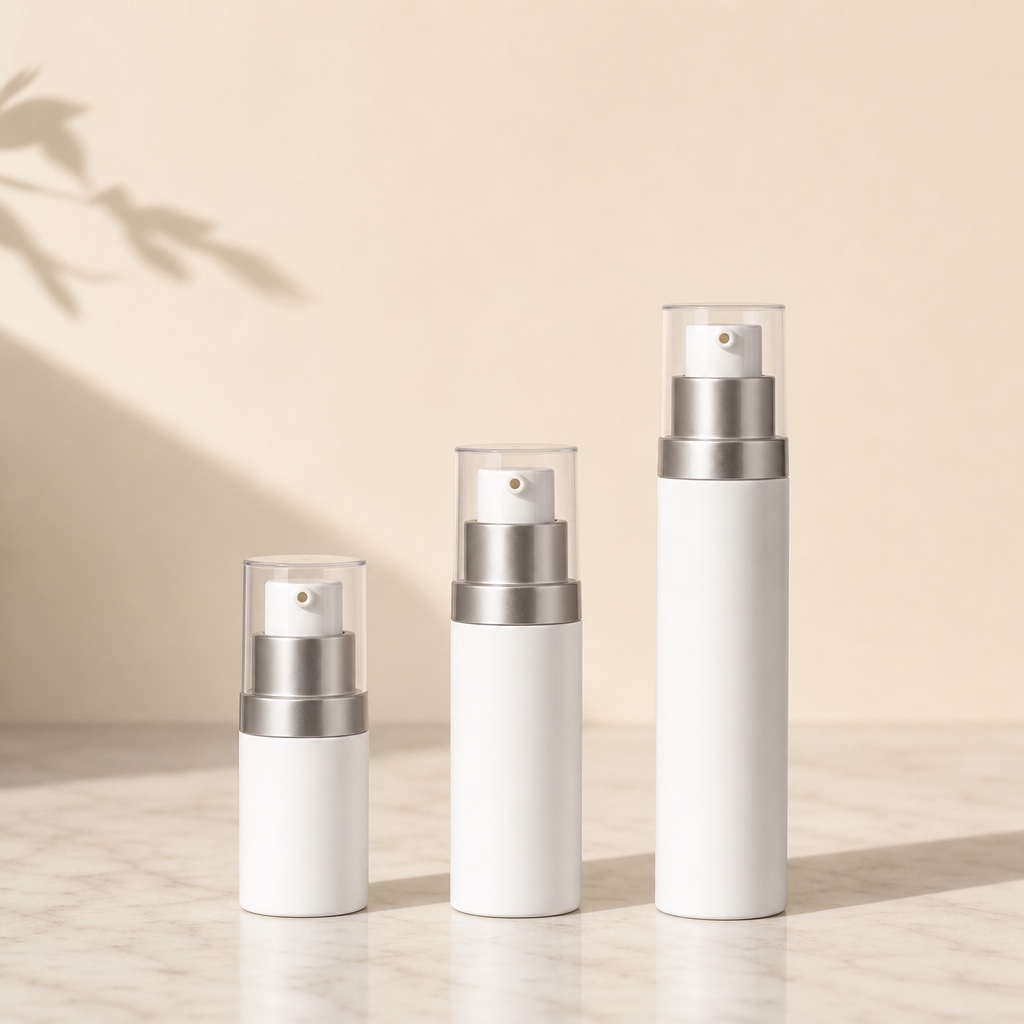
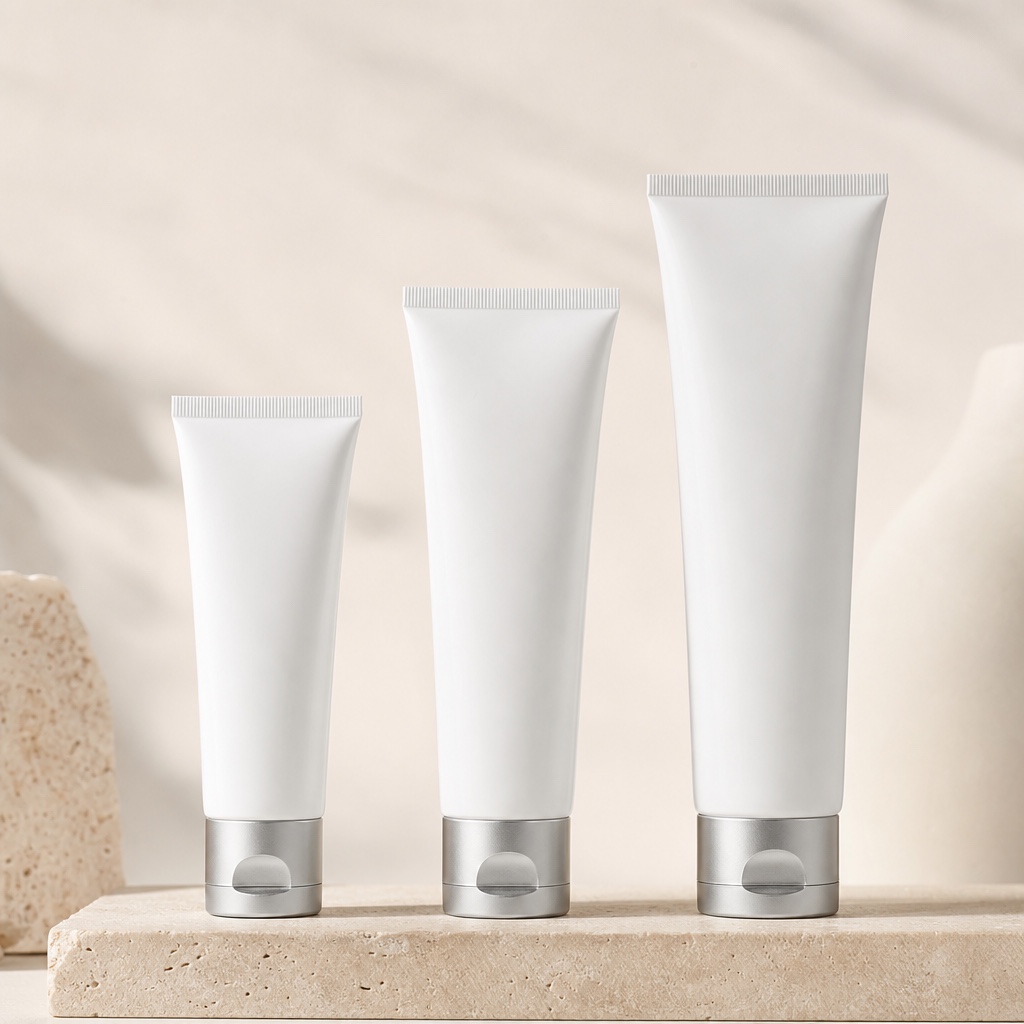
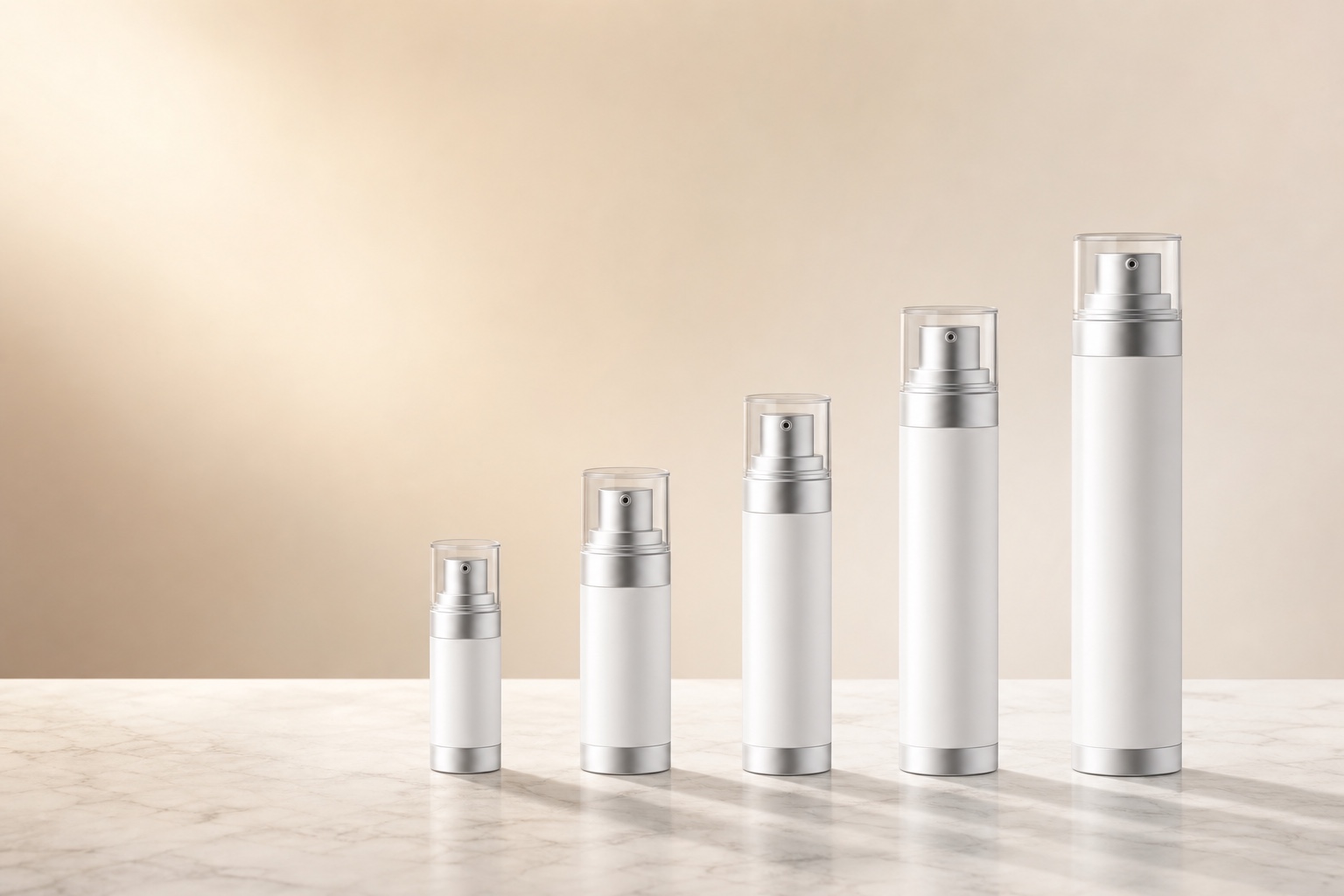
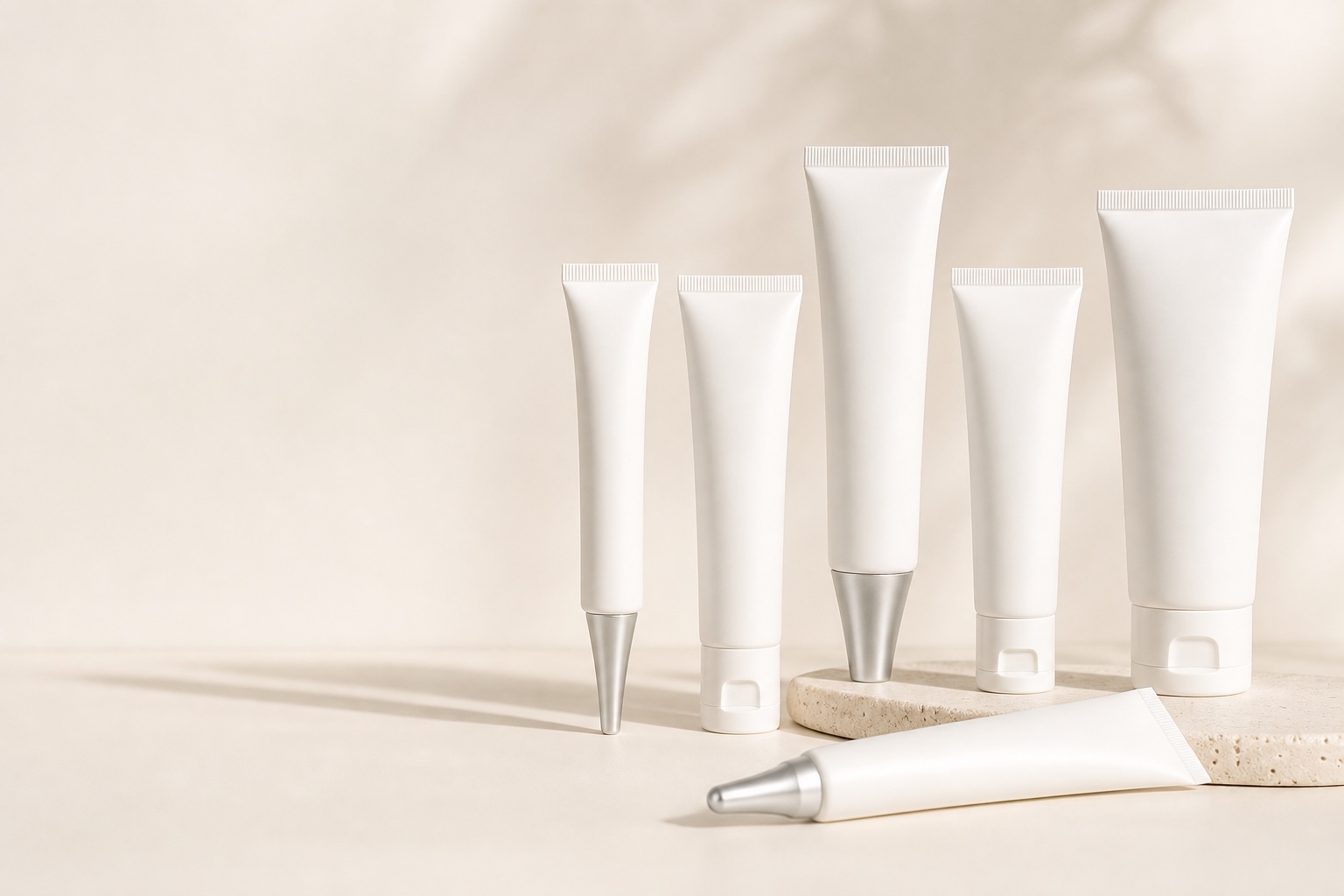
Sunscreen actives can degrade with air exposure, which is why an airless pump is often the best format for SPF. It seals the formula in a collapsing inner pouch or piston, so no air gets in — protecting the UV filters, preventing oxidation and dispensing almost every drop. That's both a performance benefit and a luxury one: the clean, precise dose feels premium. For lighter, travel and body sunscreens, a squeeze tube is the cost-effective, familiar choice — and both can be finished to match your skincare collection.
Sunscreen packaging, with numbers.
Sunscreen packaging is decided by the formula before the shape: oil-rich SPF bulks and ester-based UV filters attack AS (SAN), craze PMMA and swell standard NBR/TPE gaskets, so the contact materials are PP, HDPE, a PE/EVOH or ABL tube, or glass, with acrylic only as an outer shell. An airless pump bottle runs 10–100 ml at an indicative MOQ of ~10,000 pieces and 20–30 days; a tube runs Ø28–Ø45 at 30–150 g, 5,000–10,000 per SKU and 15–20 days. Every SPF pack is confirmed with the actual bulk at 48°C for 30 days and vacuum-leak tested at −0.08 MPa for 15 minutes, loss ≤0.5%. These are indicative ranges from vetted partner factories operating to ISO 22716 / GMP.
Specification: sunscreen formats by size
| Format | Size range | Contact materials | Closure / dispenser | Typical use |
|---|---|---|---|---|
| Airless pump bottle | 10–100 ml (30–50 ml face SPF) | PP inner; PP or acrylic outer shell (acrylic never touches the bulk) | Piston airless pump; dose repeatable to ~0.05 ml | Face SPF, tinted SPF, high-active formulas |
| Squeeze tube — face | Ø28–Ø35, 30–100 g | 5-layer PE/EVOH co-ex or ABL; single-layer PE for mineral bulks | Flip-top (200-cycle hinge) or screw cap | Face and travel SPF |
| Squeeze tube — body | Ø38–Ø45, 80–150 g; Ø50+ for 150–250 g | 5-layer EVOH co-ex or ABL | Flip-top, screw | Body sunscreen, sport, after-sun |
| Lotion bottle + pump | 200–400 ml | HDPE frosted, PP opaque, PETG | Lotion pump 2.0 or 3.5 cc; high-viscosity pump for mineral SPF | Family and body sunscreen |
| Sun spray (aerosol) | By can | Tinplate or aluminium monobloc can with internal lacquer | Spray valve with orifice and vapour-tap; gasket specified against the propellant blend | Continuous spray sunscreen |
| Wall / tolerances | — | Fit-critical dimensions ≤0.5 mm; overall ≤1.0 mm; tube wall ±0.05 mm | Thread clearance 0.1–0.8 mm on airless outer cap | — |
SPF formula conditions vs packaging materials
| Formula condition | What goes wrong | Rule |
|---|---|---|
| Oil-rich SPF, ester-based UV filters, fragrance | Attack AS (SAN), craze and cloud PMMA, swell standard NBR/TPE gaskets, extract plasticisers | PP or HDPE contact parts; glass where premium; silicone or fluoroelastomer gaskets; acrylic as outer shell only over a PP inner |
| Oxygen-sensitive actives (vitamin C, retinol, peptides, plant extracts alongside SPF) | Oxidation: browning, loss of potency, odour | 5-layer EVOH tube (OTR 0.2–1.2 vs 150–300 for mono PE), ABL, or airless pump; nitrogen flush where possible |
| Easily oxidised sunscreen emulsions | Barrier failure shows as colour and odour change at 48°C | ABL tube for sunscreens and easily oxidised bulks; co-ex must prove its barrier in the 48°C / 30-day test |
| Silicone-heavy and oil-serum SPF | Low surface tension creeps past threads and wicks through pump seals | Glass or PP with tight thread engagement; pump gasket proven against the oil |
| Alcohol above ~30% (spray sunscreens, after-sun) | PET swells, hazes and deforms; standard gaskets soften | Glass or alcohol-rated PETG; PTFE-coated or solvent-grade gaskets |
| Mineral / thick SPF (2,000–50,000 mPa·s) | Standard 0.5 ml pumps do not prime or dose | High-viscosity pump; wide-bore orifice; dose verified with the actual bulk |
| Aerosol sun spray | A gasket that swells 0.2 mm in the propellant blend is a leaking can | Gasket compound is the single most important line in the spec; matching internal lacquer |
Airless vs tube for SPF: the trade-off in numbers
| Parameter | Airless pump bottle | Squeeze tube |
|---|---|---|
| Contents protection | One-way seal; piston follows the product; no air return | Barrier by structure: EVOH 0.2–1.2 or ABL; mono PE 150–300 |
| Residue | Near zero; contents fully expelled | Some residue in the shoulder; low-cost format |
| Unit cost | 2–4× a standard lotion pump | Lowest of the three |
| Indicative MOQ | ~10,000 pcs (multi-component assembly) | 5,000–10,000 tubes per SKU; 3,000 sometimes negotiable |
| Lead time (stock) | 20–30 days; compatibility test runs in parallel | 15–20 days from sample-tube approval |
| Dose control | Single stroke ±15%; 50-stroke average within 5–10% of spec | Squeeze — no dose control |
| Weight / travel | Heavier; better for shelf | Lightest; cabin-pressure leak tested at shoulder |
| Decoration | Spray, metallising, hot-stamp on the outer shell | Offset print, plates RMB 200–300 ≈ USD 30–45 |
MOQ, mould and lead time by route
| Route | Indicative MOQ | Tooling | Lead time (factory gate) |
|---|---|---|---|
| Stock airless, standard colour | ~10,000 pcs | None | 20–30 days |
| Stock airless + sprayed or metallised outer | 10,000; spray 2,000–5,000 per set-up | Fixtures and colour matching | 30–40 days |
| Stock tube, printed | 5,000–10,000 per SKU | Plates RMB 200–300 ≈ USD 30–45 | 15–20 days |
| Stock HDPE/PP lotion bottle, undecorated | From ~500 pcs | None | 7–25 days |
| Private mould (bottle or cap) | 3,000–10,000 pcs plus tooling | Closure tooling ≈ USD 3,000–10,000; mid-size single-component tool ≈ RMB 76,500 ≈ USD 10,600 | 45–60 days mould only; 90–120 days full programme including the 48°C / 30-day test |
| Buffer | — | — | × 1.3; +15 days across Chinese New Year; sea 18–35 days |
QC thresholds for sunscreen packaging
| Test | Method | Typical pass threshold |
|---|---|---|
| Formula compatibility | Actual SPF bulk in the actual component at 48°C, RH 75%, with ambient and cold controls | 30 days: no discolouration, odour, swelling, cracking or decoration attack |
| Vacuum leak | Filled, lying and inverted in vacuum chamber | −0.08 MPa for 15 min, loss ≤0.5% (volatile or oily bulks); −0.06 MPa standard |
| Airless piston | Static: water-filled, stand 4 h; dynamic: dispense to empty | No water passes; piston rises cleanly, contents fully expelled |
| Inner–outer bottle pull / plug retention | Tensile tester | ≥50 N without separation; plug ≥30 N |
| Priming and output | Weighed over 50 strokes × 3 | ≤8 strokes water / ≤10 lotion; single stroke ±15%; ≥1,500 actuations |
| Tube seal and crush | Peel; plate load | End seal ≥20 N/cm; 15 kgf for Ø over 25 mm, no rupture |
| Thermal cycling | Oven / freezer, filled | 48°C and −15°C, 24–48 h each, no crack, leak or colour change |
| Yellowing / UV | UV 24 h, sun 1 week, or 300 W lamp at 50°C for 48 h | No visible colour shift (≈ one year of UV) |
| Drop | Filled, onto concrete | 1.5 m at 45° for bottles with closure; 76 cm–1.5 m by format |
| Decoration adhesion | 3M 600 over print; 3M 810 over cross-hatched spray | No lift; 75% alcohol soak 30 min, no coating loss |
| Colour / acceptance | D65 light against golden sample; ISO 2859-1 level II | ΔE within agreed tolerance; AQL 0 / 1.0–1.5 / 2.5–4.0 |
| Heavy metals | Third-party lab | Pb+Cd+Hg+Cr(VI) ≤100 ppm |
Decoration process × indicative MOQ for sunscreen packs
| Process | Set-up | Indicative MOQ | Notes |
|---|---|---|---|
| Sprayed matte / soft-touch | Spray line per tone | 2,000–5,000 | Coating must pass wet-rub and 3M 810 for beach and bag use |
| Screen printing | Screen per colour | ~2,000 | Tube body print uses plates instead |
| Hot stamping | Foil plate | Small one-off | Metallic logo on airless collar or cap |
| Vacuum metallising | No tooling; ≈6 h per cycle | Set-up drives MOQ | Outer shell only |
| Frosting | Acid-etch or sandblast pass | Moderate | Glass and some PETG |
| Waterproof label | Digital print | ~100–500 | BOPP / PP film for beach and sport |
Sunscreen packs fail in ways that show up months after launch — in a hot car, in a beach bag, or on a pump that primed perfectly with water. The failures below are the ones we design the test plan around.
Common sunscreen packaging failure modes and where they are caught
| Failure | Root cause | Caught at | Threshold that catches it |
|---|---|---|---|
| Acrylic shell clouds or crazes | SPF bulk in contact with PMMA; jar or bottle quoted without a PP inner | Spec | Acrylic outer shell only; PP inner cup or inner bottle |
| Pump stalls on mineral SPF | Standard 0.5 ml pump on a 2,000–50,000 mPa·s bulk; primed with water at sampling | Sample, with actual bulk | Priming ≤10 strokes non-aqueous; output ≥90%; high-viscosity pump |
| Tube leaks at the shoulder in cabin pressure | Oily bulk creeps past a wide seal at low torque | Sample | −0.08 MPa 15 min, loss ≤0.5%; inverted 24 h |
| Airless piston sticks half-way | Piston-to-wall friction wrong; outer and inner rubbing | IQC / sample | Static seal 4 h no water passes; dynamic travel to empty; pull ≥50 N |
| Pack yellows on a sunny shelf | Clear or white resin without UV additive; coating not UV-checked | Sample | UV 24 h / 300 W lamp 50°C 48 h, no visible shift |
| Formula browns or smells in the tube | Mono PE chosen for an oxygen-sensitive or ester-rich SPF | Spec | EVOH 0.2–1.2 or ABL; confirmed at 48°C / 30 days |
| Aerosol can weeps at the valve | Gasket compound not specified against the propellant blend | Spec and IQC | Gasket swelling — a 0.2 mm swell is a leaking can |
Six-module program for sunscreen packaging
| Module | What we do for sunscreen packaging | Deliverable |
|---|---|---|
| Spec | Formula sheet first (oil phase, filters, alcohol, viscosity), then format, size, structure and contact materials | Packaging Spec Sheet |
| Source | Airless vs tube costed side by side from partner factories tooled for SPF | Quote + Supplier Options |
| Sample | Samples filled with your SPF bulk; 48°C / 30-day compatibility; pump dose and cabin-pressure leak | Golden Sample + Compatibility Report |
| Mould | Private tooling only where the shape earns 45–60 days; ownership and transfer clauses | Mould Ownership Agreement |
| QC | IQC / IPQC / FQC / OQC to the thresholds above; UV yellowing on the decorated part | Inspection Report |
| Ship | Summer heat and CNY buffers; carton spec for weight | Production Calendar + Packing Standard |
The nine hard rules behind the compatibility table are on our formula-to-packaging compatibility matrix; tube structures, barrier numbers and the print-area table are on cosmetic tube specifications, and the airless test sheet is on airless, pump and sprayer specifications. Face SPF as part of a routine is covered in the skincare packaging solution. The gates and thresholds follow our cosmetic packaging quality standards, and the questions to ask before you commit are in how to evaluate a China packaging supplier. Related formats: airless bottles and cosmetic tubes.
Related standards:
Sunscreen is a hard formula —
the pack has to keep up.
SPF formulas are oily, active-heavy and often thick. Four things we control so the packaging performs.
Formula compatibility
Chemical UV filters and high oil content can swell or stress-crack some plastics. We arrange a compatibility test between your actual formula and the material before committing.
Pump dispensing for thick SPF
A thick or mineral sunscreen needs a pump sized for high viscosity. We match the airless pump dosage and orifice to the formula so it actually dispenses cleanly.
Seal & leak integrity
Oily formulas find every weak seal. We leak-test airless bottles and tube shoulders on samples, especially for travel and cabin-pressure conditions.
Finish durability on the beach
Sunscreen packs live in bags, sand and heat. We specify durable coatings and waterproof decoration, and test rub and water resistance on samples.
Frequently asked about sunscreen packaging.
Often ordered alongside sunscreen.

Read before you brief us.
- Airless vs Tube for Sunscreen: Dose, UV Protection, Cost and MOQ
- Do Chemical SPF Filters Attack PET or PP Packaging? Compatibility and the 48°C/30-Day Test
- Sunscreen Bottle Options: Tube, Airless, Pump Bottle and Stick — Sizes, SPF Compatibility and MOQ
- Sunscreen Packaging at Low MOQ from China: Airless, Tube or Bottle for SPF
Not sure what to specify? Use the Packaging Spec Builder — formula, volume, quantity and launch date in, a 12-line spec sheet with MOQ verdict and order-by date out.
Tell us the SPF & size,
we'll find the pack.
Send your formula type (chemical/mineral, face/body), size and quantity — we'll recommend airless or tube, arrange compatibility testing and come back with an indicative price within 24 hours.