Squeezable. Matte.
Everything you need to
brief us in one page.
Shampoo 500 ml + conditioner 400 ml = classic pair
PETG (glass-like clarity, heavier feel) · PCR options
Anti-fingerprint on dark matte
24/410 · 28/410 necks · colour-matched
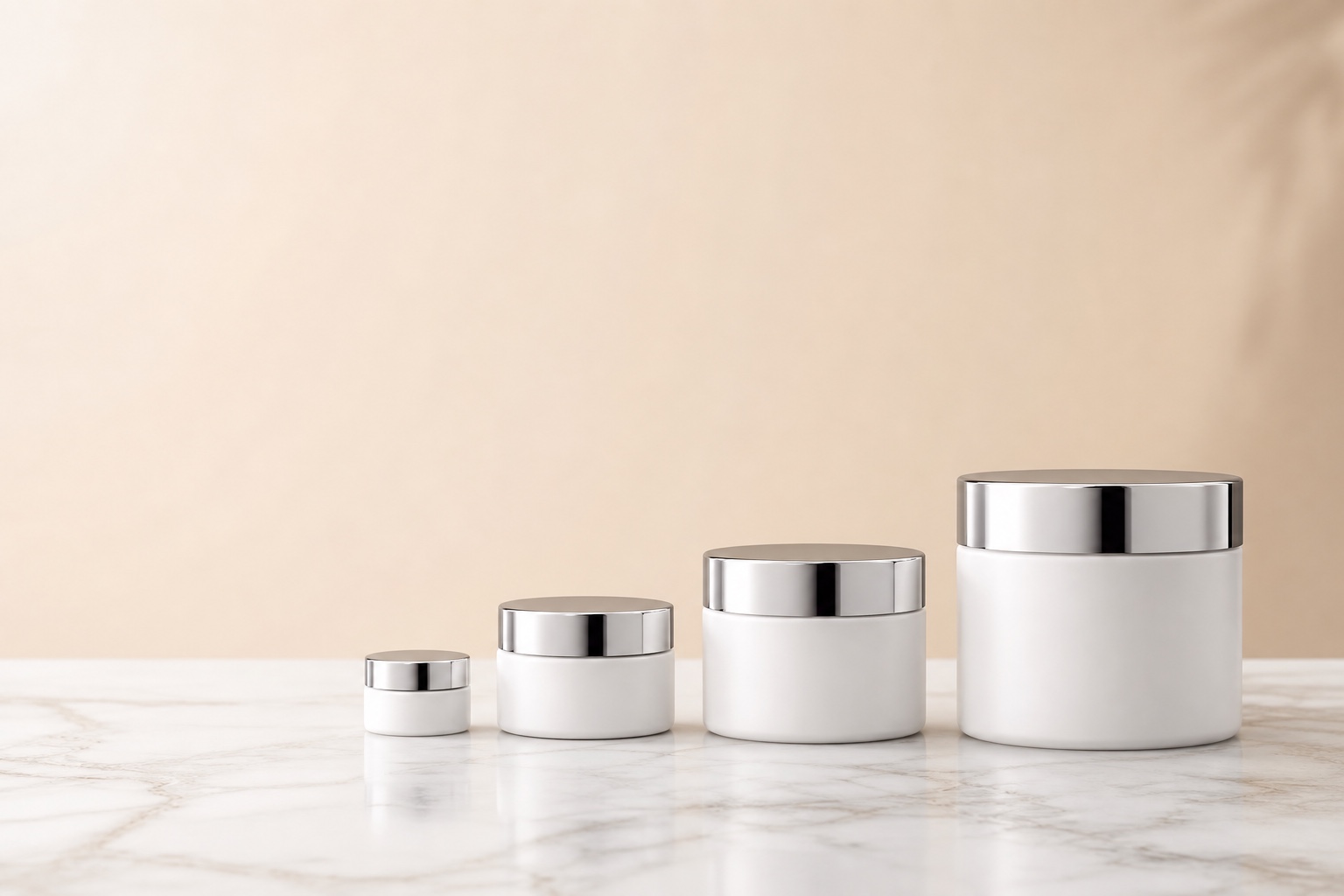
+ matching hair mask jar available
Waterproof label for shower use
Refill-pouch compatible
Custom mould 60–90 days
The right plastic
for the shower.
HDPE is the standard for shampoo and conditioner — it's light, shower-safe, squeezable, chemical-resistant and cost-effective, and it takes a soft-touch matte finish beautifully. Choose PETG when you want glass-like clarity and a heavier, more premium feel — it costs more and is less squeezable. Both can be sprayed to the same matte white or Pantone, so a full haircare line — shampoo, conditioner, and a matching hair mask jar — reads as one family.
HDPE shampoo bottles, with numbers.
For a 200–500 ml shampoo or conditioner bottle, HDPE is the default: partner factories hold stock moulds at 200 · 250 · 300 · 400 · 500 · 750 · 1,000 ml with 24/410 or 28/410 necks, and PET is reserved for clear gels because it fails above about 30% ethanol. An undecorated stock bottle runs 7–25 days at the factory gate from about 500 pieces; a sprayed matte colour needs 2,000–5,000 pieces and 30–40 days; a private blow mould adds 45–60 days for the tool. Lotion pumps dose 2.0 or 3.5 cc per stroke, must recover ≥95% of an aqueous fill and survive ≥1,500 actuations. Figures are indicative ranges negotiated with vetted partner factories operating to ISO 22716 / GMP.
Specification: size, material and closure by product
| Product | Format and size | Material | Closure | Notes |
|---|---|---|---|---|
| Shampoo | Bottle 250–500 ml (stock 200 · 250 · 300 · 400 · 500 · 750 · 1,000 ml) | HDPE; PET for a clear gel; PCR-HDPE 30–100% | Disc-top or flip-top, 24/410 or 28/410 | Soft-touch matte must pass a wet-rub test |
| Conditioner / rinse-off mask | Bottle 250–400 ml; tottle for thick masks; PP double-wall jar for salon masks | HDPE; PP for jars | Flip-top with large orifice; disc-top for thinner conditioners | Viscosity ~2,000–50,000 mPa·s — orifice is a sample decision |
| Body wash / shower gel | Bottle 250–500 ml; 750–1,000 ml family and refill | HDPE or PET (clear gels) | Flip-top, disc-top, large lotion pump on 500 ml+ | 1,000 ml HDPE + large pump is the standard large-format pack |
| Body lotion / leave-in | Bottle 200–400 ml | HDPE frosted, PETG, PP opaque | Lotion pump 2.0 or 3.5 cc per stroke on 24/410 or 28/410 | Pump output ≥95% of fill for aqueous bulks |
| Refill | Spout pouch 250–1,000 ml or 1,000 ml HDPE bottle | Mono-PE laminate; PCR laminate | Spout with screw cap | Up to 80% less plastic than a rigid bottle |
| Wall and tolerances | Extrusion blow-moulded; wall specified thin enough to squeeze, thick enough to feel solid | — | — | Fit-critical dimensions ≤0.5 mm; overall ≤1.0 mm |
HDPE vs PET vs PETG vs PCR at 200–500 ml
| Material | Look and squeeze | Chemical and thermal | Where it fits | Hard rule |
|---|---|---|---|---|
| HDPE (extrusion blow) | Opaque, natural or coloured; best squeeze; takes matte and soft-touch coatings | Density 0.941–0.960 g/cm³; softening 125–135°C; good chemical resistance; recycling code 2 | Default for shampoo, conditioner, body wash | Sprayed coatings scuff on HDPE — wet-rub test written into the spec |
| PET (injection-stretch blow) | Clear, glass-like; moderate squeeze, rigid at thicker walls | Fails above ~30% ethanol (swells and hazes); avoid hot-fill above ~60°C | Clear shower gels, toners, body oils without high alcohol | Neck is formed at the preform stage and does not change during blowing |
| PETG | Clear, heavier, premium; treat as rigid | Alcohol-rated grades exist; food-contact compliant | Premium body lotion, hair oil | Costs more than PET; check each grade against the alcohol level |
| PCR-HDPE / PCR-PET | Base tone runs grey or beige and shifts by lot | As the virgin resin | 30% entry, 50% credible claim, 100% on select formats | GRS or equivalent certificate from the resin supplier on every order |
| PP | Opaque, slightly waxy; rigid | Handles pH below 4; lower dimensional precision than PET | Hair mask jars, caps, pump components | Moulded-in white and sprayed white never match each other |
Neck finish, closures and lotion pump numbers
| Item | Standard value | Notes |
|---|---|---|
| Neck finish | 24/410 and 28/410 (410 = 1.5 thread turns, medium neck height); 18/410, 20/410 for smaller sizes | Specify the neck on the bottle drawing first, then buy the closure to it |
| Screw / disc-top opening torque | 0.2–0.7 N·m; reverse torque ≥2.5 N·m without slipping | Application torque 0.6–1.2 N·m for seal testing |
| Flip-top opening force / hinge life | 0.5–3.5 N·m; 100 cycles at 180° on bottle flip-tops, no fracture | A weak hinge pops open in a bag |
| Lotion pump neck sizes | Φ18, Φ20, Φ22, Φ24, Φ28, Φ33, Φ38 mm | Around eleven parts — stock (common-mould) pumps are the default |
| Lotion pump dose | 0.5/0.7 · 1.0/2.0 · 3.5 · 5.0 cc per stroke; 2.0 or 3.5 cc typical for body lotion | Single stroke ±15%; 50-stroke average within 5–10% of the specified dose |
| Pump priming and output | ≤5 strokes aqueous, ≤10 non-aqueous; ≥95% / ≥90% of fill recovered; ≥1,500 actuations; return ≤3 s | A cream that primes in 5 strokes with water can need 15 with oil — test with the actual bulk |
| Dip tube | Tolerance +2/−1 mm; 5 mm clearance from the base on a 250 ml bottle | Measured to 0.02 mm |
MOQ, mould and lead time by route
| Route | Indicative MOQ | Tooling | Lead time (factory gate) |
|---|---|---|---|
| Stock HDPE mould, natural or stock colour, undecorated | From about 500 pcs (by the carton) via partner factories | None | 7–25 days (7–10 if in stock; 15–25 if a run is required) |
| Stock mould + screen-printed logo | ~2,000 pcs | Screen per colour | +5–7 days on the base cycle |
| Stock mould + sprayed matte / soft-touch colour | 2,000–5,000 pcs | Spray line set-up and colour matching | 30–40 days; colour approved on a sprayed sample first |
| Moulded-in custom colour | 5,000–10,000 pcs | Masterbatch and purge | Add 3–15 days for colour-matched masterbatch |
| Custom-colour or metallised closures | ~10,000 pcs | Plating line per tone | Below 10,000 most factories stock caps in black and white only |
| Private blow mould (your shape) | 3,000–10,000 pcs plus tooling | Closure tooling ≈ USD 3,000–10,000; a mid-size single-component tool ≈ RMB 76,500 ≈ USD 10,600 | 45–60 days mould only; 90–120 days full programme |
| Buffer | — | — | Quoted cycle × 1.3; +15 days across Chinese New Year; sea 18–35 days |
QC thresholds for a shampoo bottle order
| Test | Method | Typical pass threshold |
|---|---|---|
| Vacuum leak | Filled, capped, lying and inverted in vacuum chamber | −0.06 MPa for standard bulks; −0.08 MPa 15 min, loss ≤0.5% for volatile formulas |
| Static seal | Filled, capped, inverted | 24 h, no leakage |
| Coating adhesion (matte / soft-touch) | 3M 810 over 2 mm cross-hatch, pulled at 45°; wet-rub | No lift; pencil hardness ≥2H on sprayed surfaces |
| Thermal | Oven and freezer, filled | 48°C and −15°C 24–48 h each; closures −24°C / +50°C, no crack, leak or colour loss |
| Drop | Filled bottle with closure onto concrete | 1.5 m at 45°, no functional damage |
| Pump life | Continuous actuation, dose weighed over 50 strokes × 3 | ≥1,500 cycles; output ≥95% aqueous |
| Torque | Torque meter | Opening 0.2–0.7 N·m; application torque matched to your filling line |
| Colour | Against signed golden sample under D65 | ΔE within the agreed tolerance; shampoo and conditioner judged side by side |
| Heavy metals | Third-party lab | Pb+Cd+Hg+Cr(VI) ≤100 ppm |
| Acceptance | ISO 2859-1 general level II | AQL 0 critical / 1.0–1.5 major / 2.5–4.0 minor |
Decoration process × indicative MOQ for HDPE bottles
| Process | Set-up | Indicative MOQ | Notes |
|---|---|---|---|
| Screen printing | Screen per colour | ~2,000 | Cylindrical bottles count as one colour; shaped as two or more |
| Sprayed matte / soft-touch | Spray line per tone | 2,000–5,000 | PP needs flame treatment; HDPE coatings must pass wet-rub |
| Moulded-in colour | Material changeover and purge | 5,000–10,000 | Pair must come from one masterbatch lot |
| Hot stamping | Foil plate | Small one-off | Flat or gentle curves |
| Electroplated / metallic caps | Plating line per tone | ~10,000 | Exterior parts only |
| In-mould labelling | Mould modification | Tied to the mould | Wash-off-proof full-body graphics; label change = tooling change |
| Label / shrink sleeve | Digital print | ~500 | Specify BOPP or PP synthetic film for shower use, not paper |
A shampoo bottle is a commodity that fails in predictable ways. Each failure below has a threshold that catches it before the goods ship, and a gate in the process where the check belongs.
Common HDPE bottle failure modes and where they are caught
| Failure | Root cause | Caught at | Threshold that catches it |
|---|---|---|---|
| Matte coating marks and rubs off in the shower | Cheap spray on HDPE without a wet-rub requirement in the spec | Sample approval | 3M 810 cross-hatch no lift; pencil hardness ≥2H; wet-rub written into the spec |
| Flip-top pops open in a bag or drips | Neck and cap drawings from different suppliers; hinge under-designed | IQC on closures | Hinge 100 cycles at 180°; opening force 0.5–3.5 N·m; 24 h inverted no leak |
| Shampoo and conditioner are two different whites | One sprayed, one moulded-in; or two spray runs | Golden sample | Pair sprayed in one run, judged side by side at ΔE under D65 |
| Pump loses doses after a month | Ball-seat leak under the spring; actuator loose on the valve | IQC pump sampling | ≥1,500 actuations; dose average within 5–10% of spec; output ≥95% |
| Clear PET bottle hazes and swells | Styling water or scalp tonic above ~30% ethanol put in PET | Spec, before sourcing | Glass or alcohol-rated PETG for >30% ethanol |
| Order lands in March instead of January | Confirmed in January without the Chinese New Year allowance | Order review | Cycle × 1.3; +15 days across CNY; Q1 goods confirmed by the first week of December |
| Refill pouch does not fit the bottle neck | Pouch spout and bottle neck bought separately | Spec | One neck drawing for bottle, cap and spout — same T and I dimensions |
Six-module program for HDPE shampoo bottles
| Module | What we do for HDPE shampoo bottles | Deliverable |
|---|---|---|
| Spec | Size pair (e.g. 500 ml + 400 ml), neck 24/410 or 28/410, wall weight, finish, closure and pump dose | Packaging Spec Sheet |
| Source | Stock-mould options from partner factories; sprayed vs moulded-in colour costed side by side | Quote + Supplier Options |
| Sample | Sprayed samples, wet-rub and snap tests, pump primed with your actual shampoo | Golden Sample + Compatibility Report |
| Mould | Private blow mould only when the shape justifies 45–60 days; ownership and transfer written down | Mould Ownership Agreement |
| QC | Four gates with the thresholds above; ΔE across the pair under D65 | Inspection Report |
| Ship | Calendar with ×1.3 buffer and holiday allowances; carton grade per weight | Production Calendar + Packing Standard |
Neck finishes, torque and hinge thresholds are set out on our neck finish and closure standards reference; pump sizes, dose stability and the output measurement method are on airless, pump and sprayer specifications. The full format table for shampoo, conditioner, body wash and refills is in the haircare and bodycare packaging solution. Inspection gates follow our cosmetic packaging quality standards, and the supplier questions are in how to evaluate a China packaging supplier. Related formats: cosmetic tubes for treatments and deodorant packaging to complete the line.
Related standards:
Four details that make a
shower bottle feel premium.
HDPE is a commodity — the difference between a cheap-feeling bottle and a premium one is in the finish, the cap and the wall.
Soft-touch coating quality
A cheap matte spray rubs off and marks in the shower. We specify a durable soft-touch coating and run an abrasion + wet-rub test on samples, so the finish survives daily shower use.
Flip-top snap & seal
A weak flip-top pops open in a bag or drips. We test the snap force and seal on the cap and match neck-to-cap tolerance so it clicks shut cleanly and doesn't leak.
Wall weight & squeeze
Too thin feels cheap; too thick won't squeeze. We spec wall weight to balance a premium hand-feel with the right squeezability for the formula viscosity.
Colour match across the pair
Shampoo and conditioner must be the exact same colour to look like a set. We spray both in one run against a master standard and approve a swatch per batch.
Frequently asked about shampoo bottles.
Complete the haircare line.
Read before you brief us.
- Airless Pump Bottles from China: A Sourcing Guide for Indie Skincare Brands
- Airless vs Regular Pump Bottle for Serum: Which Should an Indie Brand Choose?
- 500 ml HDPE Shampoo Bottle with Lotion Pump: MOQ, Lead Time and Cost from China
- HDPE vs PET for a Shampoo Bottle: Material, Neck Finish (24/410 vs 28/410) and Leak Test
- How to Open a Pump Bottle That Won't Open: Lock-Down Pumps, Twist-to-Lock, Clip Locks — and What Brands Should Specify
- Lotion Pump Dose (2 ml vs 4 ml) and the 1,500-Cycle Test: What to Specify
Not sure what to specify? Use the Packaging Spec Builder — formula, volume, quantity and launch date in, a 12-line spec sheet with MOQ verdict and order-by date out.
Tell us the line,
we'll match the set.
Send your sizes, quantities and finish — shampoo, conditioner, and any body or mask products — and we'll come back with matching bottle options, cap choices and an indicative price within 24 hours.